Why does mould keep coming back on the bathroom ceiling?
It is the same ceiling every time. Above the shower, around the fan, or a grey line following the cornice all the way round. You wipe it, it looks fine for a few weeks, and then it is back in exactly the same place. Bathroom ceilings are the most common thing we get called to on the Gold Coast, and across the jobs I did in July it came down to the same three things over and over.
The short answer
The short answer. Mould grows on a bathroom ceiling because a shower puts a large amount of moisture into a small room, and that moisture lands on the coldest surface it can find. Nearly always the ceiling. Whether it becomes a problem depends on three things: whether the moisture can get out of the room, where it goes if it does, and whether that ceiling runs cold. Every bathroom job I attended in July failed on at least one of those three, and two of them failed on more than one.
It is the same ceiling every time. Above the shower, around the fan, or a grey line following the cornice all the way round. You wipe it, it looks fine for a few weeks, and then it is back in exactly the same place.
Bathroom ceilings are the most common thing we get called to on the Gold Coast, and across the jobs I did in July it came down to the same three things over and over.
Every bathroom job I attended in July failed on at least one of those three, and two of them failed on more than one.
The main causes
Cause 1
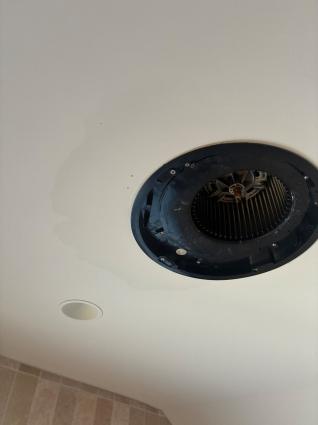
Cause one is extraction. There is no fan, or there is one that cannot move air because the grille and housing are choked with lint and dust.
Cause 2
- Cause two is where the fan discharges. A fan that vents into the roof cavity takes the moisture out of the room and delivers it onto the other side of the same ceiling.
Cause 3
- Cause three is insulation. Where a section of ceiling has no insulation over it, that section runs colder than the ceiling around it and becomes the first place condensation forms.
- Growth that follows the cornice line all the way round is its own version of cause three, because insulation is rarely fitted hard into the wall and ceiling junction.
The main causes explained
Cause one: the moisture cannot get out of the room
The first thing to check is whether the room has working extraction, because if it does not, everything else is academic.
At a house in Parkwood in late July there was no exhaust fan in either the bathroom or the en suite. Not a blocked one, not a weak one. None. Every shower put moisture into those rooms with nowhere for it to go but the ceiling.
For reference, the National Construction Code 2022 Housing Provisions, Part 10.8.2, sets a minimum exhaust flow rate of 25 litres a second for a bathroom or sanitary compartment, and 40 litres a second for a kitchen or laundry, and requires that the exhaust discharge directly to outdoor air rather than into a roof or wall cavity. I am not a building certifier and a report of mine is not a compliance assessment, and existing buildings are not required to be upgraded to current provisions. It is still the benchmark worth knowing, because it tells you what a wet room is supposed to be able to do.
The other version of cause one is subtler and more common. At a bathroom in Currumbin there was a fan, and it ran. The grille and housing were heavily blocked with accumulated lint and dust. A fan that cannot move air is the same as no fan, and it is worse in one respect, because everyone in the house believes the problem is handled.
That room read 24.3 degrees and 62.1 per cent relative humidity, giving a dew point of 16.6 degrees. Outside at the same time it was 24.7 degrees and 52.9 per cent. The moisture was being made and held in that room.
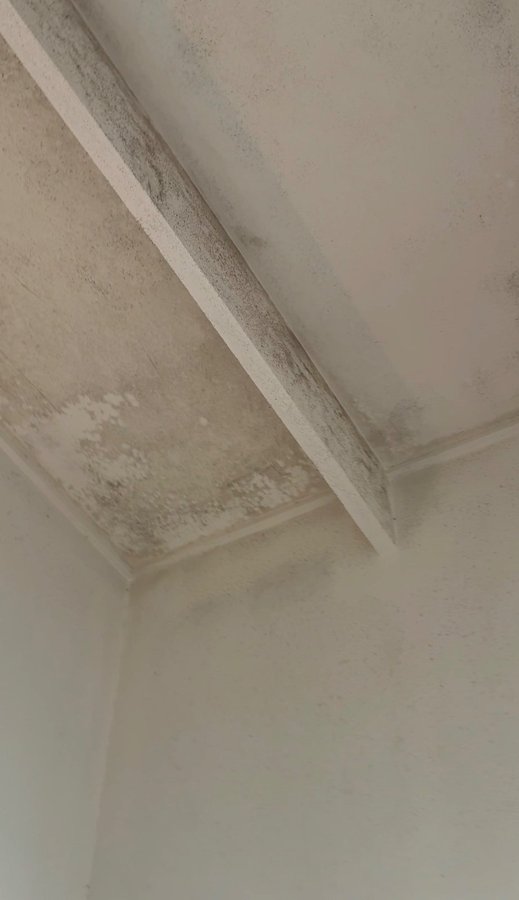
Mould growth on a raked bathroom ceiling and exposed timber beams at a Currumbin property
Cause two: the fan vents into the roof cavity
The second thing to check is where the fan actually discharges, because a lot of them do not go outside.
At a home in Ormeau the bathroom fan was ducted into the roof cavity rather than to the exterior. The moist air was being drawn out of the bathroom and dumped into the ceiling space directly above it, where it settled on the cold side of the same ceiling it had just left.
That is the one that catches people out, because the fan looks like it is doing its job. It sounds right, the mirror clears, and the moisture is being delivered a metre and a half away on the other side of the plasterboard.
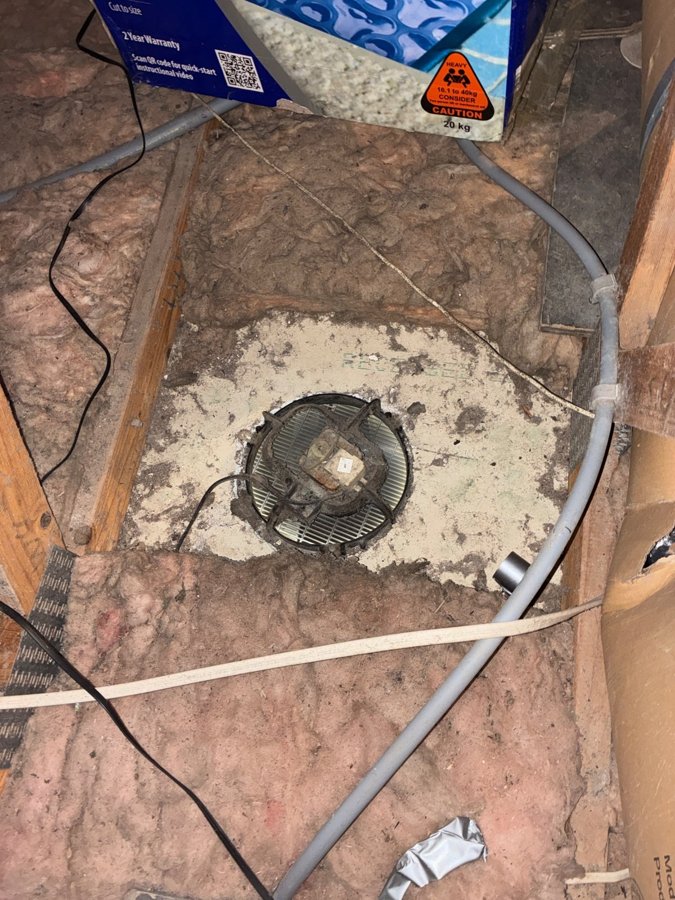
Bathroom exhaust fan discharging into a roof cavity at an Ormeau property
The Ormeau roof space. The fan housing sitting in the ceiling with the moist air discharging into the cavity rather than out of the building.
Cause three: part of the ceiling runs cold
The third thing is insulation, and it is the one that explains why the growth comes back in the same shape every time.
Insulation does not make a ceiling warm or cold. It separates the room from the roof space. Where it is missing or pushed aside, that section of ceiling stops following the room and starts following the roof space above it, and the roof space gets colder than the rooms below it overnight. That section becomes the coldest surface in the room while the moisture from the evening shower is still hanging around, and the coldest surface is where condensation forms first, sits longest and dries slowest.
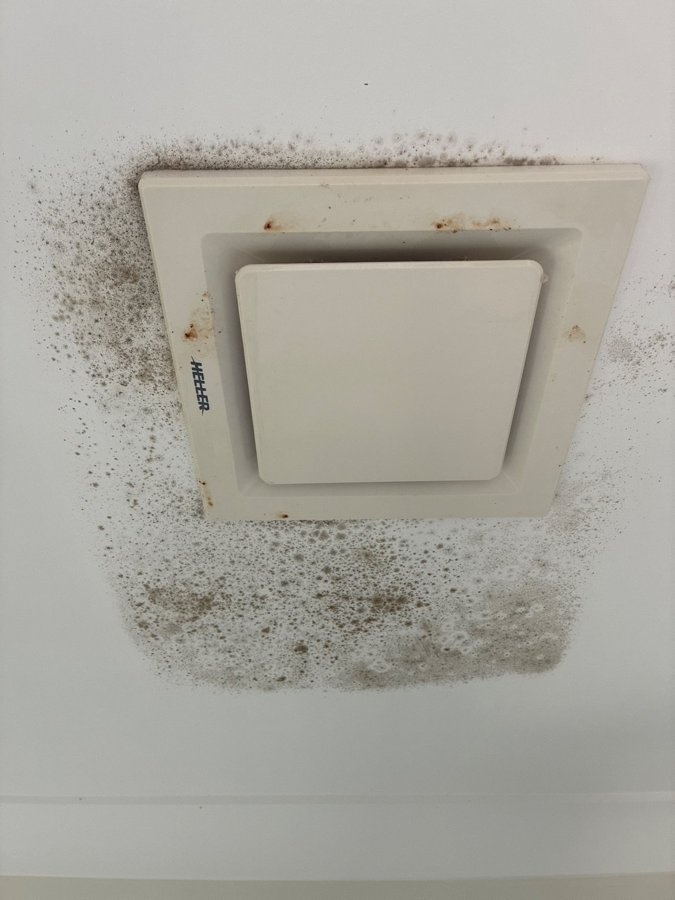
At an en suite in Pimpama the growth was fine speckling radiating outward from the exhaust fan housing with a denser patch below it, and nothing on the walls, joinery or floor. The thermal camera picked up a cooler plane across the ceiling exactly where the growth was. Up in the roof space the batts were not continuous: a section directly above the growth had no insulation over it, with the batts displaced to either side and the fan housing sitting in the middle of the gap.
Bathroom exhaust fan discharging into a roof cavity at an Ormeau property
Pimpama. The growth radiates out from the fan penetration, and stops where the insulation above it starts again.
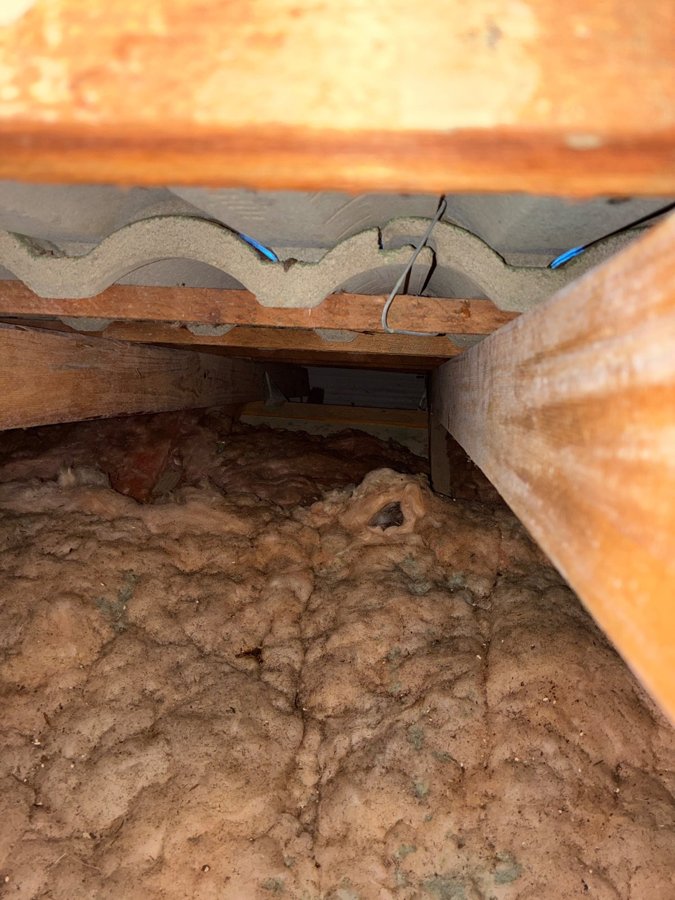
At Ormeau it was both at once. The insulation around the fan was torn away or missing, and the fan was discharging into that same cavity. Colder ceiling and more moisture delivered to it, in the same square metre.
Bathroom exhaust fan discharging into a roof cavity at an Ormeau property
The Ormeau roof space. Insulation displaced and missing above the affected areas, which is what the growth below was tracking.
Why does it follow the cornice line?
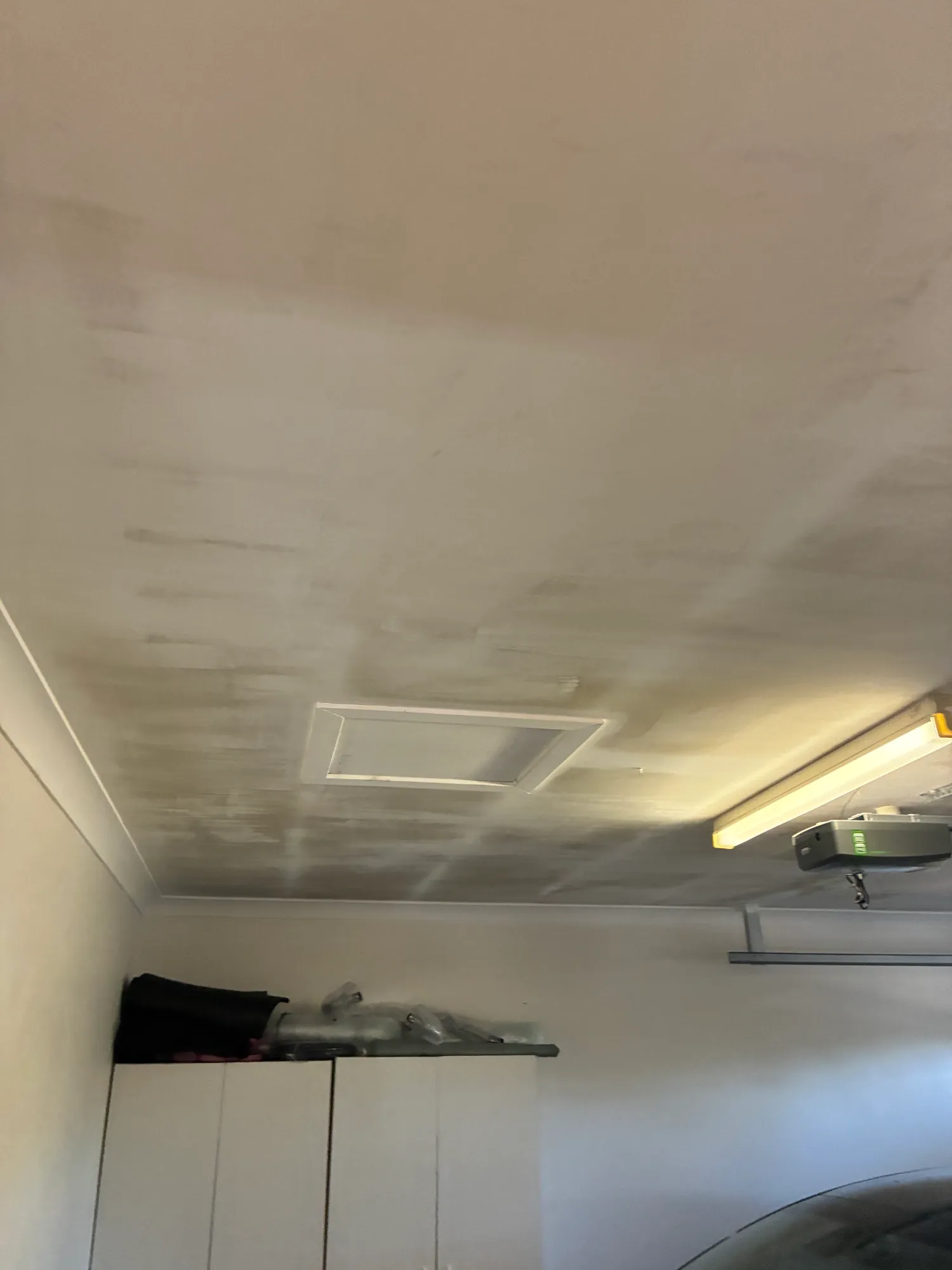
Growth along the cornice and into the corners is the same cold surface problem in a different place. Insulation is rarely fitted hard into the wall and ceiling junction, so the corners run colder than the middle of the ceiling.
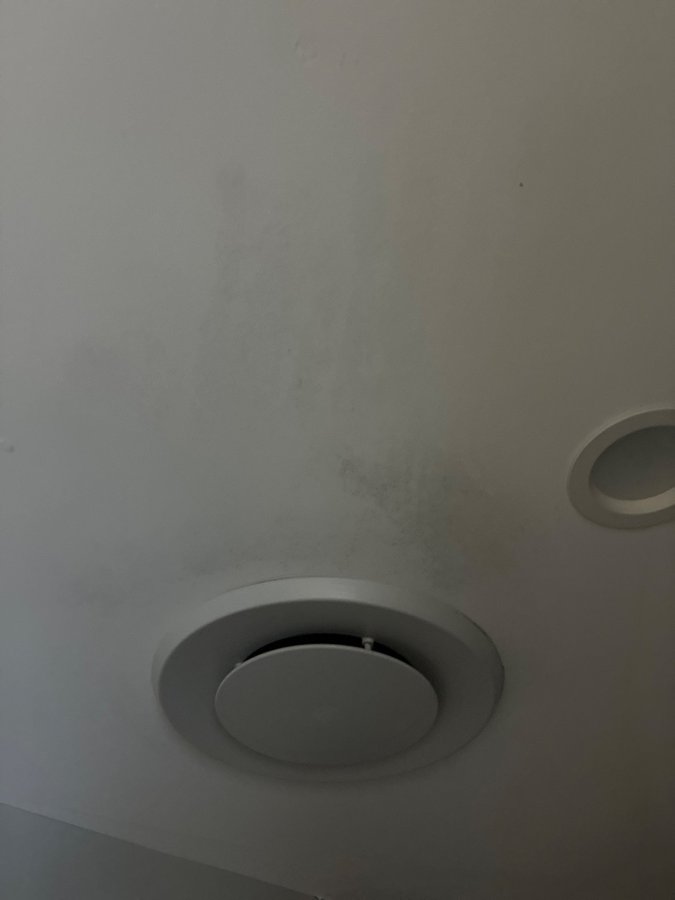
At Ormeau the bedroom growth was concentrated in the corners and along the upper wall and cornice junction, in a speckled pattern. That room read 17.2 degrees and 72.7 per cent, against 65.7 per cent outdoors, so the humidity was internal and the corners were simply the first surfaces to give it somewhere to land.
Mould growth surrounding an air con vent at an Ormeau property
Growth tracking the cornice line. This pattern is a cold surface pattern, not a cleaning pattern.
Is it ever something other than those three?
Yes, and this is worth saying plainly. Sometimes there is water in the ceiling and the answer is a repair rather than ventilation.
The signs are different. A leak leaves staining, a tide mark, sagging, or a patch of ceiling that feels soft, and the growth follows the water rather than the cold spots. Condensation growth is speckled, spread across a plane, and it sits on material that is sound and dry to the touch.
At Ormeau there was discolouration and staining along the cornice line on top of the condensation pattern, which is consistent with a current or past water source. I do not carry leak detection equipment, so that gets referred to a plumber or builder to confirm or rule out rather than guessed at. Two causes in one room is normal.
What actually stops it
In this order, because the order matters.
- Get extraction that works. A fan that meets the benchmark, ducted directly to outside, not into the roof. If there is a fan already, take the grille off and look at it before you assume it is fine.
- Make the insulation continuous. Get into the roof space above the wet room and look at whether the batts are actually covering it, particularly around the fan housing and downlights.
- Confirm or rule out a leak where there is staining, sagging or a soft patch, before anything gets treated.
- Then treat what is there. That clears the growth and the air, and it holds once the first three are done.
Steps one and two are building work by your own trades, and they do the heavy lifting. Nothing I do on the surface changes a ceiling that goes cold every night.
Common Questions
Will an exhaust fan fix mould on the bathroom ceiling?
Only if it actually extracts and it discharges outside. A fan blocked with lint moves very little air, and a fan ducted into the roof cavity moves the moisture onto the other side of the same ceiling. Check both before deciding the fan is not the problem.
Why does the mould come back in exactly the same spot?
Because that spot gets colder than the rest of the ceiling overnight, usually because there is no insulation above it. Condensation forms on the coldest surface available, so it returns in the same place and often in the same shape as the gap above it.
Is mould on the bathroom ceiling a leak?
Usually not. Most bathroom ceiling growth is condensation. A leak tends to leave staining, a tide mark, sagging or a soft patch and the growth follows the water. If any of those are present it should be confirmed by a plumber or builder before anything is treated.
Can I just paint over it?
Painting over growth on a sound ceiling covers it and does not change the condition that grew it, so it comes back through. If the ceiling has been wet and the material is damaged, paint is doing even less, because the growth is inside the sheet rather than on it.
Get it looked at properly
If you have wiped the same ceiling more than twice, the answer is above it. We measure the room, get into the roof space, and tell you which of the three it is in writing.
Nick Smart, Mould Mates
Nick Smart is a qualified carpenter and IICRC certified mould inspector at Mould Mates, working across Brisbane, the Gold Coast and the Northern Rivers.
Common questions
Will an exhaust fan fix mould on the bathroom ceiling?
Only if it actually extracts and discharges outside. A fan blocked with lint moves very little air, and a fan ducted into the roof cavity moves the moisture onto the other side of the same ceiling.
Why does mould come back in exactly the same spot on the ceiling?
Because that spot gets colder than the rest of the ceiling overnight, usually because there is no insulation above it. Condensation forms on the coldest surface available, so it returns in the same place and often in the same shape as the gap above it.
Is mould on the bathroom ceiling a sign of a leak?
Usually not. Most bathroom ceiling growth is condensation. A leak tends to leave staining, a tide mark, sagging or a soft patch, and the growth follows the water rather than the cold spots.
Can I paint over mould on the bathroom ceiling?
Painting over growth on a sound ceiling covers it without changing the condition that grew it, so it comes back through. If the ceiling has been wet and the material is damaged, the growth is inside the sheet rather than on it.
About the author

Nicholas Smart
Nicholas Smart co-founded Mould Mates after 15 years as a qualified carpenter, and is studying a Bachelor of Construction Management. That background is the reason he tends to find the cause rather than the patch. Mould is a building problem before it is anything else, and knowing how a roof, a wall cavity or a subfloor is put together is what tells you where the water is getting in and why the same corner keeps growing the same thing. He works across the Gold Coast and Northern Rivers.
- Qualified carpenter, 15 years on the tools
- Studying a Bachelor of Construction Management
- Co-owner of an IICRC Certified Firm