What the last 90 mould inspections actually found
The last 3 months of Mould Mates inspection records: bedrooms beat bathrooms nearly three to one, condensation caused more of it than leaks, and the average house had it in four rooms.
The short answer
I write up every job. Between 2 July and 28 September 2026 that came to more than 90 inspections across the Gold Coast and the Northern Rivers, in 60 suburbs. This is what three months of them looks like in one place. Seventy two of the jobs were on the Gold Coast and twenty one in the Northern Rivers, spread across sixty suburbs, so it is not one pocket of one town. Some of it confirmed what I already tell people. One number surprised me.
What the last 90 inspections found
- Bedrooms were the worst room by a long way. 152 spots with growth in them, against 53 in bathrooms.
- Condensation and poor airflow were behind 192 of the 315 rooms with a cause recorded against them. Leaks accounted for 128.
- Nine in ten houses had mould actually growing on the material, not just settled on the surface of it.
- The average house had growth in 4.3 rooms, not one. 401 separate spots in total.
- One area in four needed something opened up before the extent could be established.
- Ten houses had both condensation and a leak. The two are not alternatives, and looking for one can hide the other.
Bedrooms, not bathrooms
This is the number I did not expect. Everyone assumes mould is a bathroom problem, including most of the people who call me. In three months of reports the bedroom came up nearly three times as often.
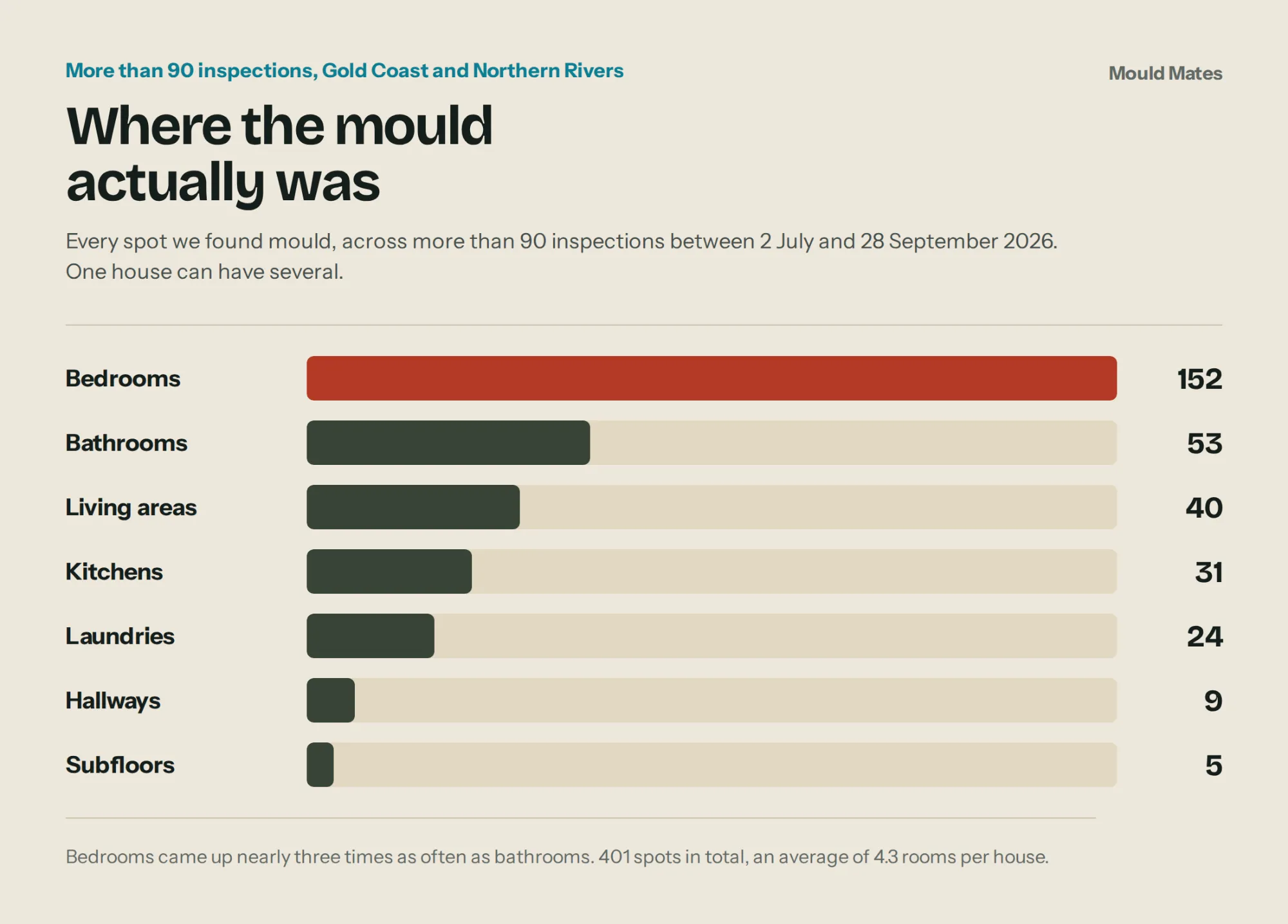
Affected areas by room across more than 90 inspections, 2 July to 28 September 2026.
It makes sense once you stop thinking about water and start thinking about air. A bathroom is wet for twenty minutes and usually has a fan and a door. A bedroom is closed up for eight hours a night with people breathing in it, often with the windows shut, often on the cool side of the house, and frequently with a wardrobe full of clothes against an external wall. Nothing dramatic happens. The room just never gets a chance to dry out.
Bathrooms are still where people see it first, because tiles and grout show a mark early. Bedrooms are where the growth is quietly doing more.
The other thing that shows up in a bedroom is the wardrobe. Growth on the back wall of a robe, on the underside of shoes, on the shoulders of a coat that has not moved since autumn. A wardrobe on an external wall is a small, unventilated box with a lot of fabric in it, and fabric holds moisture. If I am called to a bedroom, the robe is the second place I look.
Condensation caused more mould than leaks
Counting rooms rather than houses, because one cause can wreck four rooms and another can wreck one: of the 315 rooms in jobs where I wrote down a cause, 192 came back to condensation, poor airflow or plain high humidity. 128 involved a leak. 56 were water getting in from outside, 21 were damp coming up from the ground, 17 were the air conditioner.
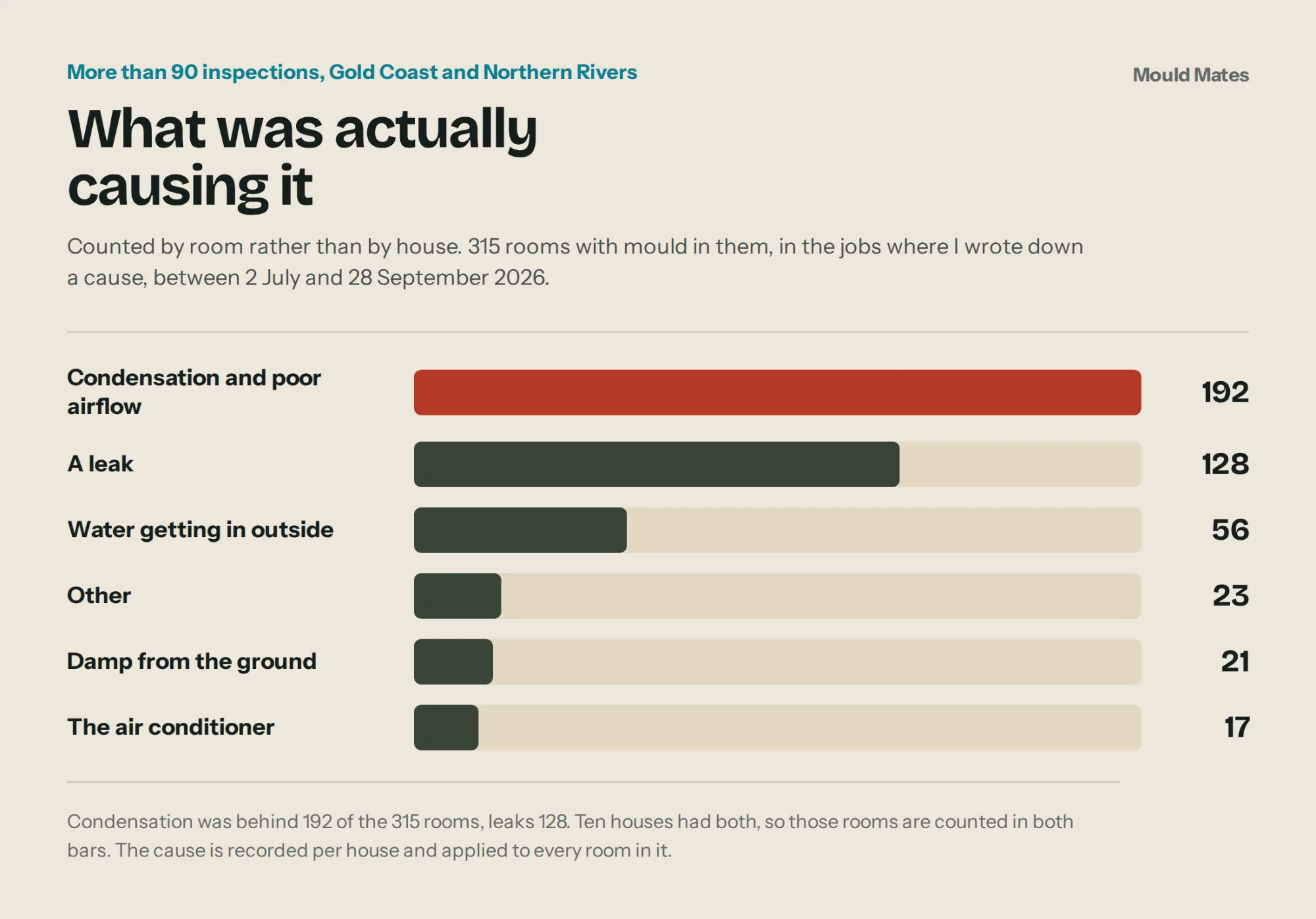
What was causing it, counted by room rather than by house.
That is the single most useful thing in here. Most people calling about mould are hunting for a leak, and most of the time that is not what is doing the damage. The water was already in the air, and the building gave it a cold surface to land on.
Ten houses had both, which is the trap. Find the leak, fix the leak, and the growth carries on, because the airflow was never the thing you went looking for.
It was almost never one room
401 separate spots in three months. An average of 4.3 rooms per house.
People ring about one patch. By the time the inspection is finished it is usually four or five areas, because whatever is driving it is a property of the house rather than of that one wall. Humidity does not stay in the room it was made in.
This is also why quoting off a photo does not work, and why I will not do it. The photo shows the room that bothered you. It says nothing about the other three.
Nine in ten had it growing, not just sitting there
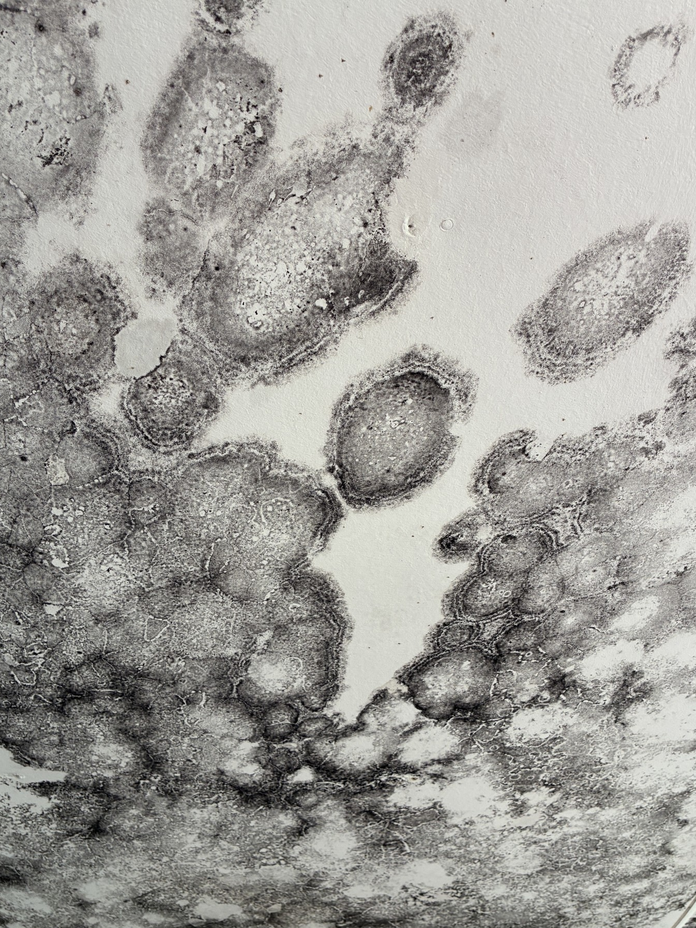
There is a difference between mould that has settled on a surface and mould that has taken hold in the material. The first wipes off. The second is feeding on what it is sitting on. In 84 of the houses it had taken hold. In five it had only settled, and in one there was nothing beyond what you would expect in any home. The standard I work to calls those three states Condition 3, Condition 2 and Condition 1, and it is the only place in this post where that language earns its keep.
Part of that is just who rings me. People call when they can already see something. But it does mean that by the time most people pick up the phone, it has stopped being a job you can wipe away.
One spot in four, 102 of the 401, needed something opened up or cut out before I could see how far it went. That is the part nobody budgets for, and the reason looking beats guessing.
Air sampling went out on 19 of them, and six of those went to the laboratory for analysis. I do not sample every job and I would be suspicious of anyone who does. Sampling earns its place when there is a smell and nothing visible, when growth keeps returning, or when somebody needs a written finding for a landlord, a body corporate or an insurer.
The words that kept appearing in my notes
I went back through the observation notes on all 401 areas and counted what I had actually written.
- Fan, 40 mentions. Missing, not running, too weak, or discharging into the roof cavity instead of outside. The most common single fault in the set.
- Insulation, 40 mentions. Displaced, missing over a section, or compressed. Gaps make the cold spot, and the cold spot is where the moisture lands first.
- Vent, 27 mentions. Subfloor vents blocked by garden beds, wall vents painted over, roof spaces with no air moving through them.
- Cavity and behind, 35 mentions between them. Growth on the side of the material nobody looks at.
None of those are cleaning problems. All four are building problems, and three of them are cheap to fix compared with what they cause.
What this changes for your house
If you have growth in a bedroom, stop looking for a leak first. Look at what the room does overnight, whether air moves through it, and whether the ceiling above it has insulation across the whole span.
If you have growth in more than one room, the cause is almost certainly the building rather than any one appliance or pipe.
If you can see it and what it is growing on is sound and dry, that is a mould treatment. If water has been into the material, the material comes out, which is remediation. If it keeps coming back, or you can smell it and cannot find it, that is what a mould investigation is for.
How I counted this
Every figure here comes from our own inspection records for the period, not from a survey or an industry report.
- 93 inspections carried out between 2 July and 28 September 2026 across the Gold Coast and the Northern Rivers. 72 Gold Coast, 21 Northern Rivers.
- Room counts are every spot I logged on each job, so one house can contribute several. 401 in total.
- Cause is what I wrote down on the day, in my own words, grouped afterwards. It is recorded per house, so when counting by room every room in a house takes that house’s cause. 13 houses have no cause written down, which is 86 rooms, and those are left out of the cause figures.
- A job counted as both condensation and a leak appears in both figures, which is why the categories add to more than 100 per cent.
- This is one firm, one region, one quarter, and people who already suspected a problem. It is not a random sample of houses and I would not present it as one.
Common questions
Where is mould most commonly found in a house?
In our own records across more than 90 inspections on the Gold Coast and in the Northern Rivers, bedrooms came up most often with 152 spots, ahead of bathrooms at 53, living areas at 40, kitchens at 31 and laundries at 24. Bathrooms tend to be where people notice it first because tile and grout show a mark early.
Is mould usually caused by a leak?
Not most of the time. Counting by room across 315 rooms with a cause recorded, condensation and poor airflow accounted for 192 and a leak for 128. Ten houses had both, so finding a leak does not rule out an airflow problem.
How many rooms does mould usually affect?
More than one. Across more than 90 inspections the average was 4.3 rooms per house, because whatever grows the mould is usually a property of the building rather than of one room.
What does it mean when mould is growing in the material?
It means the mould is feeding on what it is sitting on rather than resting on the surface, so treating the surface will not get it. The standard we work to, ANSI/IICRC S520, calls this Condition 3, and the answer is to remove the material rather than treat it in place. That was the case in 84 of our inspections in this period.
Why does mould grow in a bedroom with no water in it?
Because the moisture is in the air rather than in a pipe. A closed bedroom holds the moisture people breathe out overnight, and any cool surface, typically a ceiling under a gap in the insulation or an external wall behind a wardrobe, gives it somewhere to condense.
Mould investigation and treatment, Gold Coast and Northern Rivers
If any of this sounds like your house, a mould investigation establishes the cause and puts it in writing with the readings behind it. If it is surface growth on sound, dry material, a mould treatment handles the growth and the air. Call 0435 219 425 or request a free quote.
About the author

Nicholas Smart
Nicholas Smart co-founded Mould Mates after 15 years as a qualified carpenter, and is studying a Bachelor of Construction Management. That background is the reason he tends to find the cause rather than the patch. Mould is a building problem before it is anything else, and knowing how a roof, a wall cavity or a subfloor is put together is what tells you where the water is getting in and why the same corner keeps growing the same thing. He works across the Gold Coast and Northern Rivers.
- Qualified carpenter, 15 years on the tools
- Studying a Bachelor of Construction Management
- Co-owner of an IICRC Certified Firm