Black mould explained
Black mould is not a type of mould, it is a colour. Mould comes in every colour and grows wherever it is wet. What actually decides the job on Brisbane and Gold Coast homes.
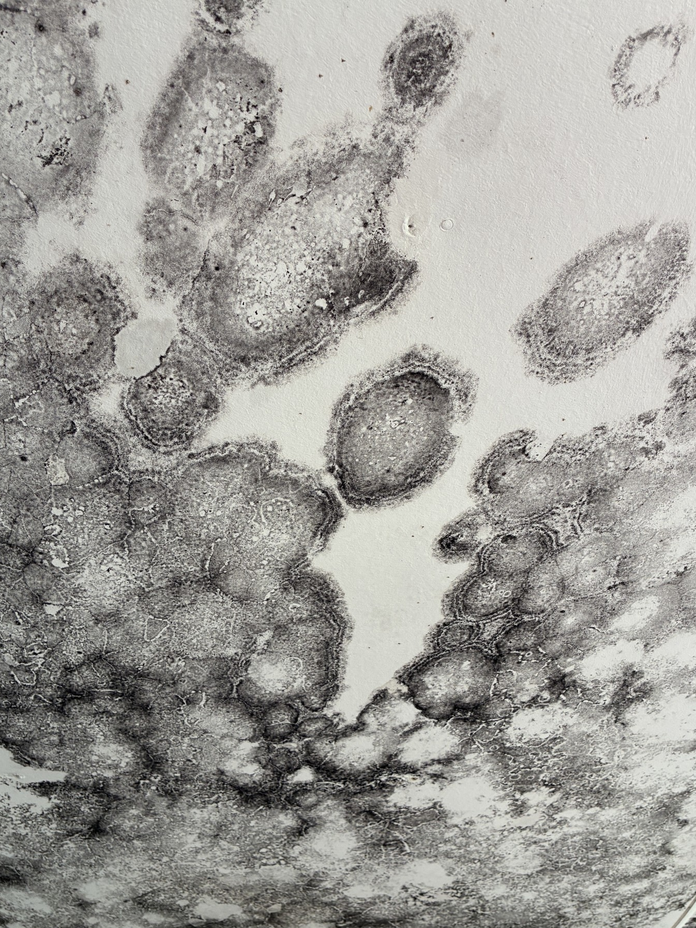
- Black mould is not a species or a type. It is a colour, and it is the one thing about a patch of mould that tells you nothing useful.
- Mould comes in every colour. Black, green, grey, brown, orange, white, and combinations of those in the one patch.
- Growth takes the colour of whatever it is on. WorkSafe Queensland states that mould comes in all colours and blends with the material it is growing on.
- All of it means the same thing about a building: a material has been staying wet long enough for something to grow on it.
- Mould does not discriminate. It grows on whatever is wet, in any house, in any suburb, new or old, spotless or not.
- What sets the scope of the work is the material it is growing on, how much of it there is, and why that material is wet. Never the colour.
Black mould explained
It is the first thing people say on the phone. Not that there is mould in the bathroom, but that they think it is the black one.
I understand why. It is the version that made the news. But after a few hundred inspections around Brisbane and the Gold Coast, the colour has never once changed what I did about it. Black is not a type of mould. It is a colour, and mould comes in all of them.
Mould comes in every colour
The same growth can look black on a dark grout line, green on a painted wall and grey on bare timber. Put a white bathroom ceiling behind it and it reads as black, because that is the strongest contrast in the room.
You cannot identify mould by looking at it. Nobody can, including me. Laboratory sampling can tell you what is present, and we use a NATA accredited laboratory when we need it, but we use it to find concealed growth and measure how much there is. Not to name a patch somebody can already point at.
If you can see it, it does not need identifying. It needs a cause.
Mould does not discriminate
This is the part I would most like people to take away, because a lot of them are embarrassed when they call.
Mould does not care how often you clean, what the house cost, how new it is, or which suburb it is in. I have found it in six month old builds and in spotless houses, and walked through plenty of untidy places with none in them. It grows where there is moisture and something to grow on. That is the whole of it.
It does not discriminate about materials either. Plasterboard, timber, silicone, grout, carpet backing, insulation paper, dust on a cold duct. If it stays wet long enough, something will take.
So when somebody tells me they think theirs is the black one, they are asking whether they have the bad version. There is no bad version. There is wet material and dry material.
Is one colour worse than another?
Not for the purposes of the job. I am not going to tell you what any mould does or does not do to people, because I am not qualified to and it is not my lane. If anyone in the house is worried about their health, that is a conversation with a doctor.
What I can tell you is that two patches which look identical can be two completely different jobs, and the difference is worth real money. It is decided by what is under the growth, not by the colour of it.
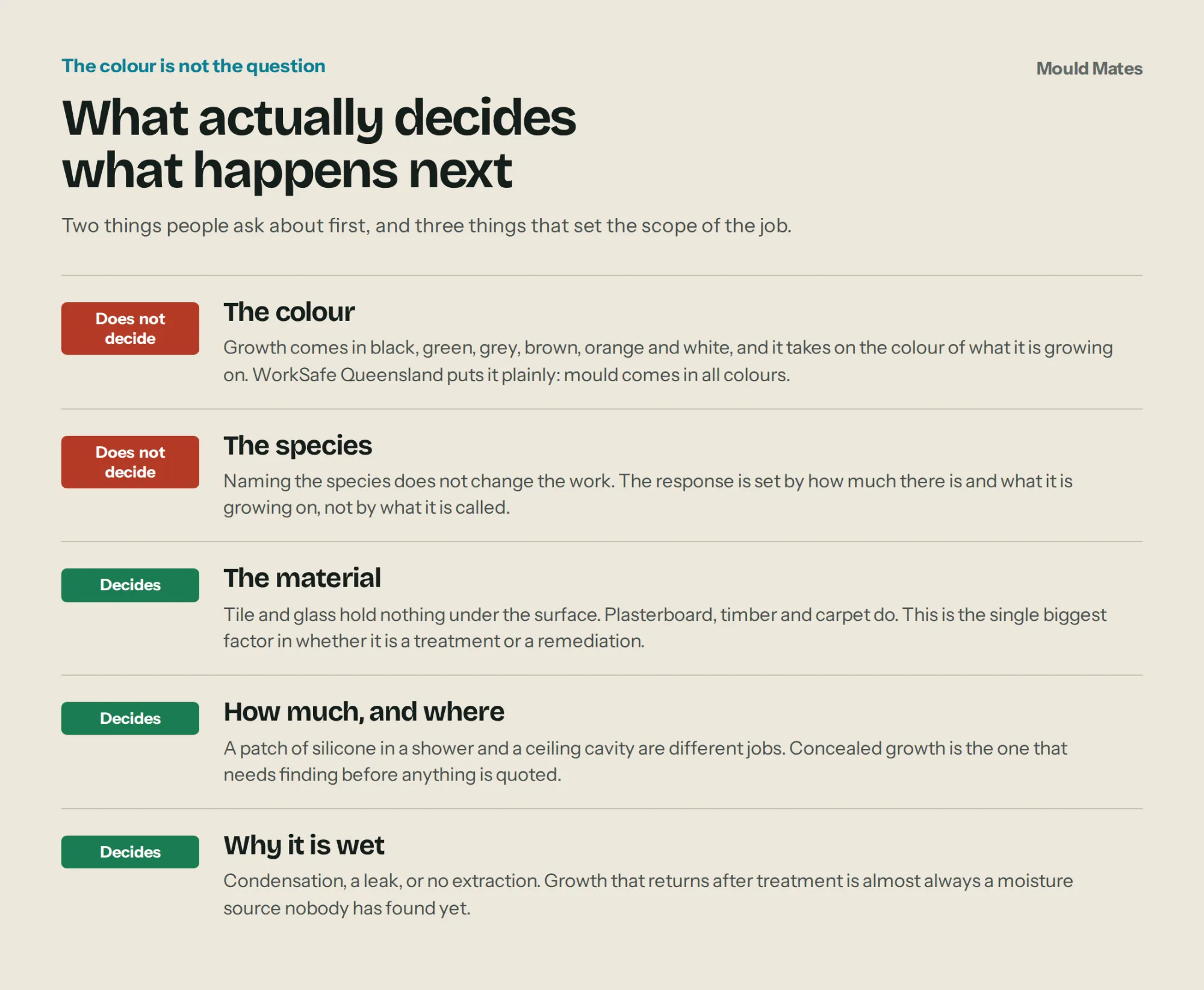
Two things people ask about first, and three things that set the scope of the job.
Why is it always the bathroom?
Because a bathroom in this climate is a cool surface and a moisture supply in the same small room, and on the Gold Coast and in Brisbane that combination runs most of the year.
Silicone beads, grout lines and the ceiling above the shower are where it shows up first. Silicone in particular holds growth inside the bead, which is why it goes dark, comes up after a wipe and then returns in the same line a few weeks later.
If it keeps coming back on the ceiling that is usually extraction rather than hygiene, which we covered in why mould keeps coming back on the bathroom ceiling, and if the mark vanishes under a supermarket spray but the growth does not, that is does bleach kill mould.
What we actually find behind it
Three jobs, three regions, and the colour was the least useful thing about all of them.
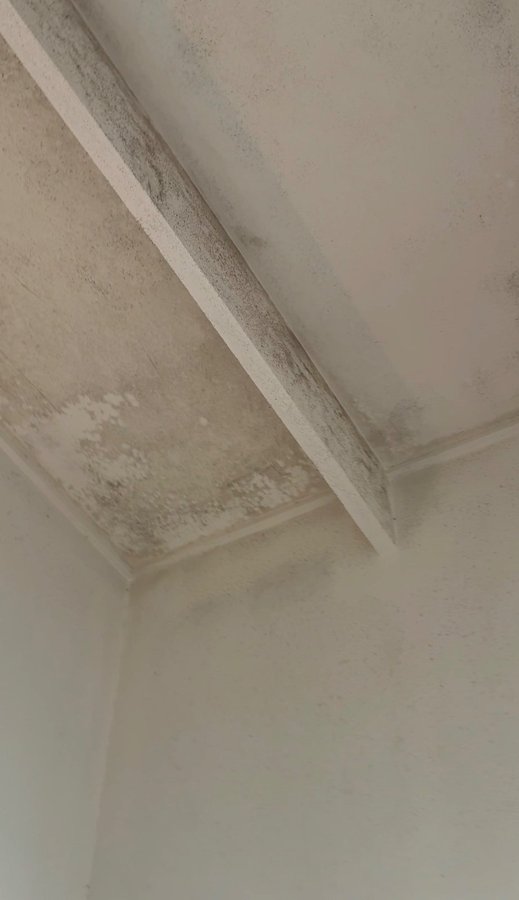
This ceiling is the classic. It is the photo people send me, and it is the one that makes everybody say the word black.
A ceiling in the Northern Rivers. This is the pattern people photograph and send through.
This one is a roof structure at Miami on the Gold Coast, looking at the back of the weatherboards. Nobody in that house was ever going to see it. No mark on the walls inside, nothing to photograph from the lounge room.
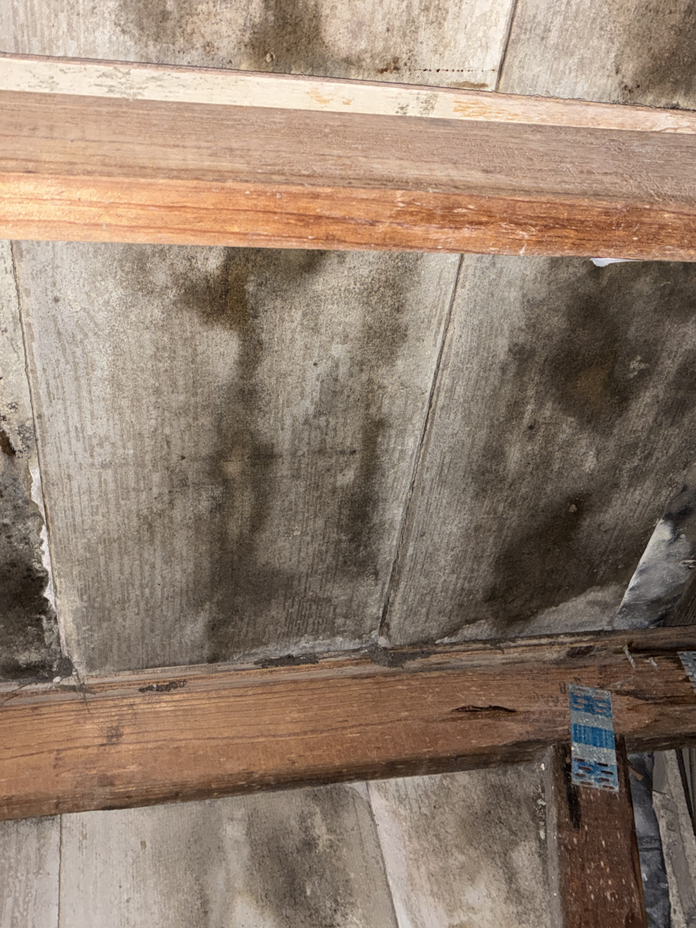
The back of the weatherboards in a roof structure at Miami. The face nobody looks at.
And a unit in Brisbane City, where the growth was on the ensuite ceiling and the cause was not in that apartment at all.
She had smelled something musty for a long time and the body corporate had been out twice to a wet ceiling. A leak detection company eventually found an active leak in the waste pipe serving the apartment upstairs, running onto ducting and settling on the top of her ensuite ceiling.
By the time I inspected it the plumbing was fixed and the ceiling had dried, so nothing was actively wet. The growth was still there, about two square metres, which under S520 is a Condition 3 area: material that comes out rather than gets treated in place. We cut the lining back five hundred millimetres past the visible growth and verified it afterwards.
This is a piece of that ceiling once it came out. The painted face is the one she had been looking at from the shower for years. The other side is what was against the cavity.
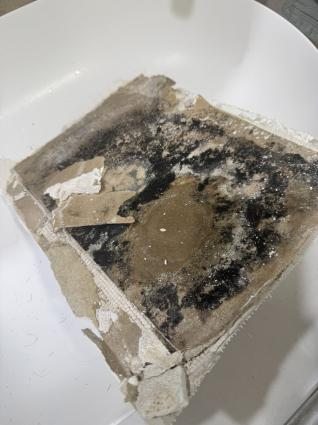
A section of the ensuite ceiling after removal in Brisbane. Clean painted face on one side, the concealed face on the other.
Three buildings, three causes, and not one of them decided by colour.
Does black mould need different treatment?
No. The material decides, not the colour.
Surface growth on sound, dry, non porous material is a mould treatment, and we handle the growth and the air in a visit. Once water has been into porous material the growth is inside it, not on it, and that is remediation under the S520 standard: the material comes out. The two are priced differently, so being straight about which one you have got is the difference between fixing it and paying twice.
The awkward ones are where a ceiling looks fine from the room and the growth is on the back of the sheet, which is exactly what the Brisbane photo above is.
When should you call someone?
WorkSafe Queensland uses roughly one square metre as the line for workplaces, above which the work goes to a professional. That is workplace guidance rather than a rule for houses, but it is not a bad gauge.
The stronger signal is not the size of the patch. It is a smell you cannot place, growth that returns in the same spot after you have dealt with it, or growth in a room with no obvious water in it. Any of those means there is a source nobody has found, and that is what a mould investigation is for: readings, thermal imaging, and a written finding that names the cause.
Common questions
What is black mould?
Black mould is a colour description rather than a species. WorkSafe Queensland states that mould comes in all colours and blends with the material it grows on, so colour cannot be used to identify it. Dark growth on a bathroom ceiling or in shower silicone is usually ordinary growth on a cool, damp surface.
Does black mould mean something worse than other mould?
Not in terms of the work. What changes the job is the material the growth is on, how much there is, and why that material is wet. Dark growth on sound, dry tile is a treatment. The same looking growth on plasterboard that has been wet is a remediation. Mould Mates does not give health advice. That question is for a doctor.
How can you tell if mould is black mould?
You cannot identify mould by looking at it. Growth takes the colour of the material it is on, so the same growth can look black, green or grey depending on the surface behind it. Laboratory sampling identifies what is present, but it is used to find concealed growth and measure how much there is, not to name visible growth.
What colours does mould come in?
Black, green, grey, brown, orange and white, often several of those in the one patch. WorkSafe Queensland states that mould comes in all colours and blends with the material it is growing on. The colour does not change what the growth means about the building or what has to be done about it.
Does black mould need to be removed differently?
No. What sets the method is the material. Growth on sound, dry, non porous surfaces such as tile and glass is a treatment. Growth in porous material that has been wet, such as plasterboard, timber or carpet, is remediation under the S520 standard and the material is physically removed.
Why does black mould keep coming back in the bathroom?
Because the moisture is still there. In Brisbane and on the Gold Coast a bathroom pairs a cool surface with a daily moisture supply, and extraction that does not run, does not move enough air, or discharges into the roof cavity leaves that moisture in the room. Growth in silicone also sits inside the bead, so it returns until the bead is replaced.
Should I get black mould tested?
Not usually, if you can see it. Testing is worth doing when there is a smell with nothing visible, when growth keeps returning after treatment, or when you need a written finding for a landlord, a body corporate or an insurer. Air sampling goes to a NATA accredited laboratory.
Mould investigation and treatment, Brisbane and the Gold Coast
If you can see it and the room is otherwise dry, a mould treatment handles the growth and the air. If it keeps returning, or you can smell it and cannot find it, a mould investigation establishes the cause and puts it in writing with the readings behind it.
We work across Brisbane, the Gold Coast and the Northern Rivers. Call 0435 219 425 or request a free quote.
About the author

Nicholas Smart
Nicholas Smart co-founded Mould Mates after 15 years as a qualified carpenter, and is studying a Bachelor of Construction Management. That background is the reason he tends to find the cause rather than the patch. Mould is a building problem before it is anything else, and knowing how a roof, a wall cavity or a subfloor is put together is what tells you where the water is getting in and why the same corner keeps growing the same thing. He works across the Gold Coast and Northern Rivers.
- Qualified carpenter, 15 years on the tools
- Studying a Bachelor of Construction Management
- Co-owner of an IICRC Certified Firm