Local Case study 2: Pimpama, mould around an ensuite exhaust fan
Fine speckled mould spreading out from an ensuite exhaust fan, with nothing wet and nothing sagging. The owner wanted to know if water was getting in. The answer was above the ceiling, not behind it.
The short answer
The mould at this Pimpama ensuite is condensation on a cold spot. A section of the ceiling had no insulation over it, so it lost heat into the roof space and ran colder than the ceiling around it. In a bathroom, the coldest surface is where moisture condenses first and dries slowest.
- An insulation gap makes a cold spot, and a cold spot in a wet room is where mould starts.
- Growth radiating out from a fan penetration is a pattern, and patterns tell you the cause.
- No sagging, staining or tide marking means you are probably not looking at a leak.
- Making the insulation cover continuous is building work for the owner’s own trades, not part of a mould treatment scope.
What causes mould to spread out from an ensuite exhaust fan?
A ring of fine speckled mould on the ensuite ceiling, spreading out from the exhaust fan like a stain that never dripped. No leak, nothing sagging, nothing wet.
The owner wanted to know whether it meant water was getting in. The answer was above the ceiling, not behind it.
What did we actually find?
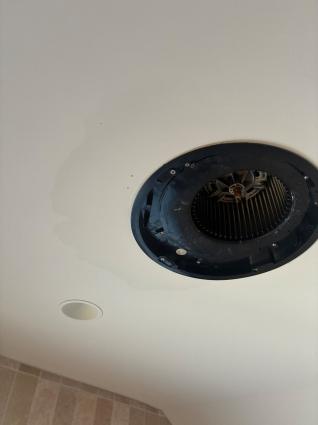
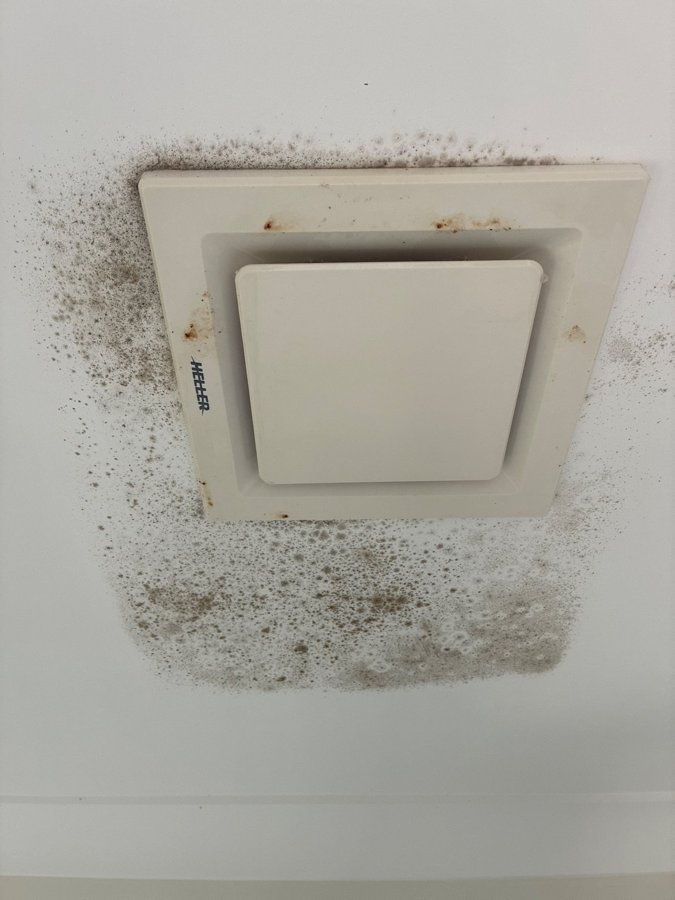
Light surface mould growth on the painted ensuite ceiling lining, concentrated around and immediately below the ceiling exhaust fan housing.
It presented as fine speckled colonisation radiating outward from the fan penetration, with a denser patch on the lining below and light staining on the fan grille itself. Growth was confined to the ceiling plane, with nothing on the walls, joinery, floor or fixtures.
The lining was sound, with no sagging, water staining or tide marking to indicate a discrete water source. Contamination was assessed as Condition 2 under ANSI/IICRC S520:2024, settled spores, across one room.
The ensuite ceiling at Pimpama. The growth radiates out from the fan penetration rather than sitting in a single wet patch.
What was above the ceiling?
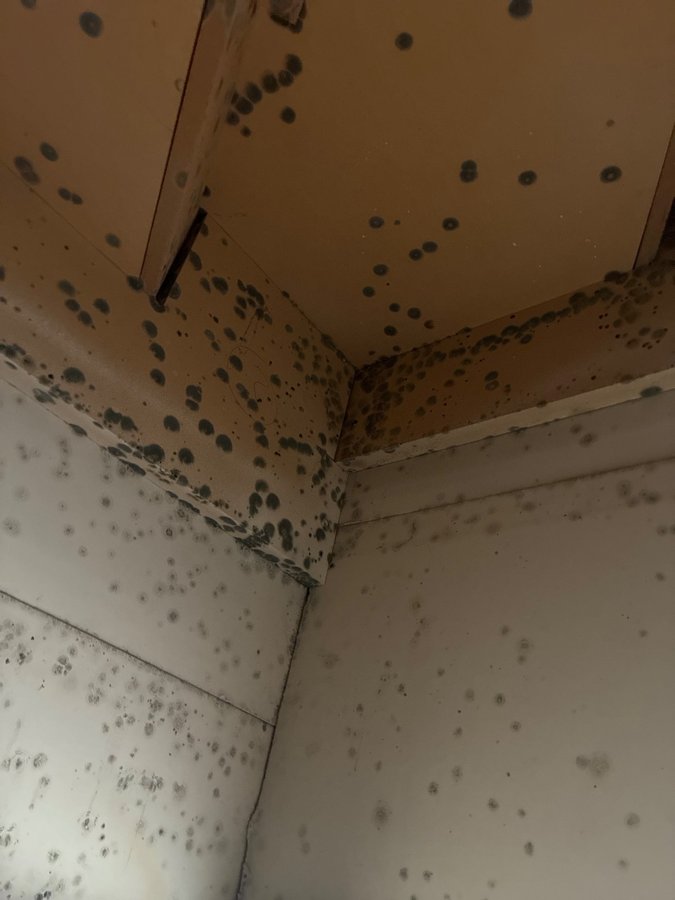
We accessed the roof space directly above the ensuite, and the insulation batts were not continuous across the ceiling.
A section of lining directly above the area of growth had been left with no insulation cover at all, the batts displaced to either side of it. The exhaust fan housing sits inside that uninsulated section. No water staining, ponding or wetting was observed on the ceiling lining, framing or roof sheeting in the area inspected.
That one observation lines up the whole job. The gap above matched the growth below.
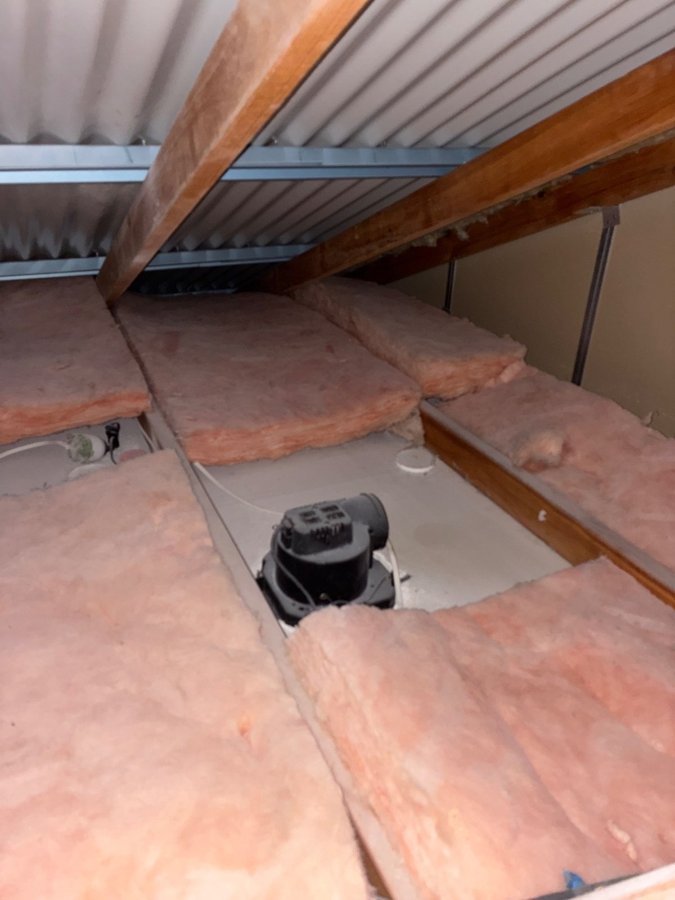
The roof space above the ensuite. The batts sit either side of the fan housing, leaving the ceiling under it uncovered.
What did the readings say?
The ensuite recorded 27.2 degrees and 56.5 per cent relative humidity, giving a calculated dew point of 17.8 degrees. Any surface at or below 17.8 will collect condensation, and showering pushes both the temperature and the moisture load well above the figures we recorded.
Thermal imaging identified a cooler surface plane at the area of growth. Its position and extent corresponded to the section of ceiling above which insulation cover was missing. No thermal indication of concealed moisture was identified elsewhere in the room.
No moisture content readings were recorded. The assessment rests on the visual observations, the roof space inspection, the thermal imaging and the psychrometric readings taken on site. If confirmation of moisture content in the lining or framing is ever needed, we can return and record it.
What is actually driving it?
Condensation, with no liquid water source involved anywhere.
Ceiling insulation does two things. It slows heat loss from the room, and in doing so it keeps the underside of the lining closer to room temperature. Where the insulation is absent, that section loses heat to the roof space and its surface temperature drops below the ceiling around it.
Pimpama sits in NCC Climate Zone 2, warm humid, where high ambient humidity and elevated dew points already favour condensation. Put a bathroom’s moisture load under a cold patch of ceiling and you get repeated surface wetting without a drop of water escaping a pipe. No leak or flood event was reported and no evidence observed points towards a leak.
What did we recommend?
An S520 surface treatment to clear the current growth, plus an ongoing mould management plan while the driver remains.
That means HEPA vacuuming of affected surfaces, an antimicrobial clean with mechanical agitation, a bleach-based alkaline product to help discourage regrowth, and whole home fogging. The fan grille comes off, gets treated and goes back on.
The other half is not ours to do. Reinstating continuous insulation cover over the ensuite ceiling is building work, specified and installed by an insulation installer or licensed builder engaged by the owner. We are not building certifiers or insulation installers, and our comments on the insulation are observations of what was there on the day, not a specification. Until that cover is continuous, the cold spot stays.
What to check at your place
- Get a look in the roof space. Displaced or missing batts over a wet room are easy to miss from below.
- Read the pattern. Growth radiating out from a fan or a vent points to a cold surface, not to a leak.
- Check the ceiling for sag or tide marks. Their absence tells you something, and so does their presence.
- Treat the fan grille as part of the job. Surface staining on a grille means it has been in the wet zone too.
Common Questions
Does mould around a fan mean the fan is faulty?
Not necessarily. At this Pimpama ensuite the lining around the penetration was simply the coldest surface available, and air movement at the fan drew moist room air against it, so the growth formed there.
Is Condition 2 less serious than Condition 3?
Condition 2 means settled spores, fragments or residues without actual growth present, while Condition 3 means visible growth is confirmed. Both are treated, and the classification changes the scope rather than whether there is work to do.
Will treatment stop it coming back?
Treatment clears what is there now. It does not warm a cold ceiling, so unless the insulation cover is made continuous the same conditions keep producing the same result, and the management plan is what holds it in check meanwhile.
Why were no moisture readings taken?
Because nothing on site indicated moisture in the materials. The ceiling was sound and unstained, the roof space showed no ponding or wetting, and the assessment rests on the visual observations, the roof space inspection, the thermal imaging and the psychrometric readings instead.
Get it looked at properly
If mould is spreading out from a fan or a vent at your place in Pimpama, the question worth answering is what sits above that ceiling. We look, we measure, and we tell you which trade owns which part of the fix.
Common questions
Does mould around a fan mean the fan is faulty?
Not necessarily. At this Pimpama ensuite the lining around the penetration was simply the coldest surface available, and air movement at the fan drew moist room air against it, so the growth formed there.
Is Condition 2 less serious than Condition 3?
Condition 2 means settled spores, fragments or residues without actual growth present, while Condition 3 means visible growth is confirmed. Both are treated, and the classification changes the scope rather than whether there is work to do.
Will treatment stop it coming back?
Treatment clears what is there now. It does not warm a cold ceiling, so unless the insulation cover is made continuous the same conditions keep producing the same result, and the management plan is what holds it in check meanwhile.
Why were no moisture readings taken?
Because nothing on site indicated moisture in the materials. The ceiling was sound and unstained, the roof space showed no ponding or wetting, and the assessment rests on the visual observations, the roof space inspection, the thermal imaging and the psychrometric readings instead.
About the author

Nicholas Smart
Nicholas Smart co-founded Mould Mates after 15 years as a qualified carpenter, and is studying a Bachelor of Construction Management. That background is the reason he tends to find the cause rather than the patch. Mould is a building problem before it is anything else, and knowing how a roof, a wall cavity or a subfloor is put together is what tells you where the water is getting in and why the same corner keeps growing the same thing. He works across the Gold Coast and Northern Rivers.
- Qualified carpenter, 15 years on the tools
- Studying a Bachelor of Construction Management
- Co-owner of an IICRC Certified Firm