Local Case Study 4: Concealed mould in a Suffolk Park studio near Byron Bay
A musty smell in a Suffolk Park studio near Byron Bay with nothing to see. What we found above the en suite ceiling, and the water source behind it.
The short answer
The smell was mould growing inside a concealed ceiling cavity above the en suite. It was on the back face of the sheeting and on top of an original raked ceiling that had been framed over during an earlier renovation, fed by a cracked sump above it. None of it was visible from any room in the unit.
- The property is a studio at Suffolk Park, just south of Byron Bay, inspected by Mould Mates on 9 July 2026.
- The only visible sign anywhere in the unit was a faint water stain around the en suite exhaust fan.
- The growth was concealed on the back of the ceiling sheeting and on top of a raked ceiling that had been framed over in a renovation.
- The moisture source was a sump with a cracked edge above that ceiling, found only once the cavity was opened up.
Concealed mould in a Suffolk Park studio near Byron Bay
A musty smell in a studio at Suffolk Park, just south of Byron Bay. Nothing to see anywhere in the unit. The owner had recently bought the place, had it professionally cleaned twice, and still could not shift the smell.
Here is what we found, how we found it, and why this particular problem turns up as often as it does through Suffolk Park, Byron Bay and the rest of the Northern Rivers.
What the owner was dealing with
A persistent musty odour through the whole studio that stayed put with the windows and doors open, and was strongest in the main living and sleeping space.
She had the place professionally cleaned twice. She was running a dehumidifier and moisture absorbers. The unit had been let short stay before she bought it, and the smell had reportedly been mentioned by guests back then, so it had been there a long while. A building and pest inspection carried out before the sale had noted nothing of concern.
That is a fairly typical set of facts for this kind of job. Everything reasonable had already been tried, and none of it had touched the actual problem.
What we found on the inspection
The inspection on 9 July combined a visual assessment, thermal imaging, moisture metering, psychrometric readings and air sampling.
Indoor relative humidity sat between 66.5 and 68.0 per cent, which is elevated but not unusual for a coastal unit at Suffolk Park. The thermal camera found no anomalies anywhere in the studio, which is worth saying plainly, because people assume a thermal camera finds mould. It does not. It shows temperature differences.
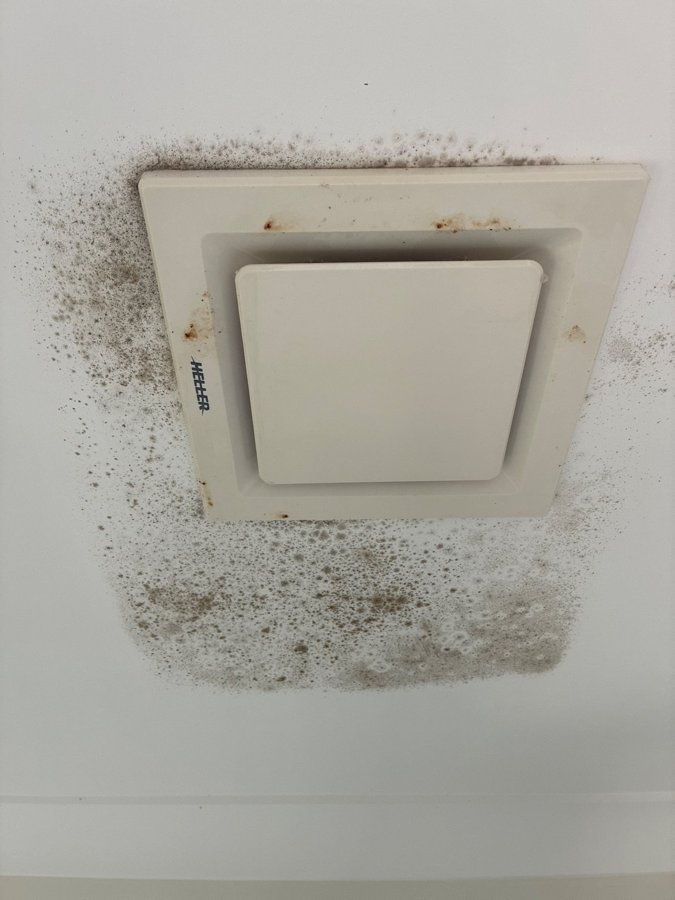
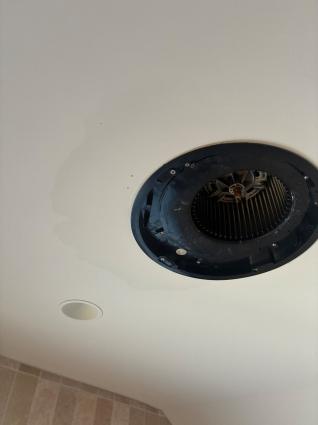
The one thing worth chasing was in the en suite: a recent looking water stain on the ceiling around the exhaust fan, with the plasterboard around it returning wet moisture readings.
The en suite ceiling with the fan cover off. A faint ring of staining around the fan was the only visible sign in the entire unit.
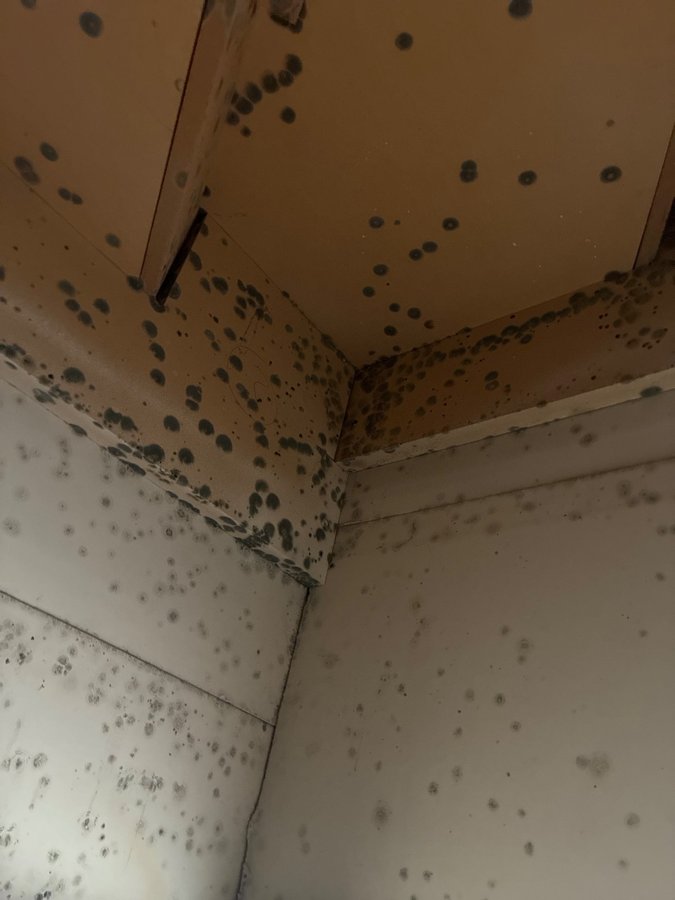
So the fan came out, and the cavity above it was photographed. Sitting above the fan was a drop ceiling from an earlier renovation, with mould growing on the original ceiling sheeting inside the cavity.
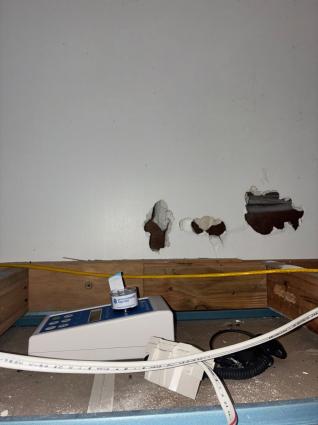
Air sampling running inside the ceiling cavity. The dark marks on the sheeting behind the pump are the concealed growth.
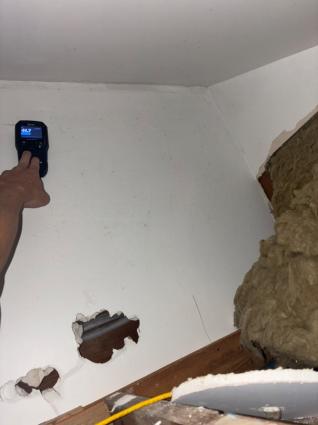
Moisture metering inside the same cavity, on the concealed face of the lining.
That cavity could not be reached from the en suite at all. Access is via a panel serving the rest of the studio ceiling, so an opening had to be formed before anyone could see how far the growth went. The affected areas were classified Condition 3 under the S520 standard: confirmed active growth.
Why nothing showed up until then
Nothing showed up because the growth was on the concealed face of the lining, and none of the usual approaches reach that far.
Cleaning treats the room. A dehumidifier treats the air in the room. A thermal camera reads surface temperature, and there was no meaningful temperature difference to read. A building and pest inspection looks at what is accessible and visible. The growth was on the other side of a ceiling that had been closed up years earlier.
That is the case for measuring conditions and investigating the cause rather than quoting off a photo. The smell was real the whole time. It just had nothing to do with any surface in the room.
What was actually above the ceiling
The cavity was opened up under containment on 6 August. The bulkhead lining above the door came off first, exposing the framing, the services, and the original raked ceiling that had been framed over during the renovation.
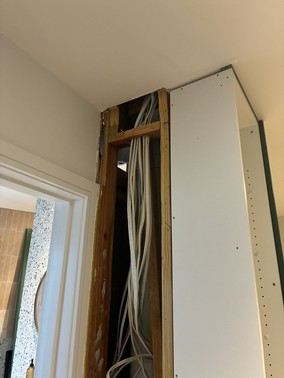
The bulkhead above the door opened up, exposing the framing and services behind the lining.
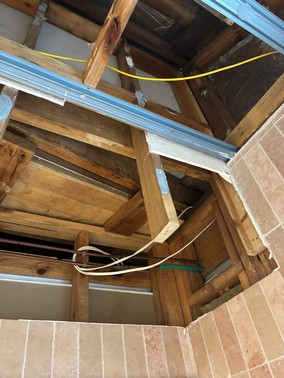
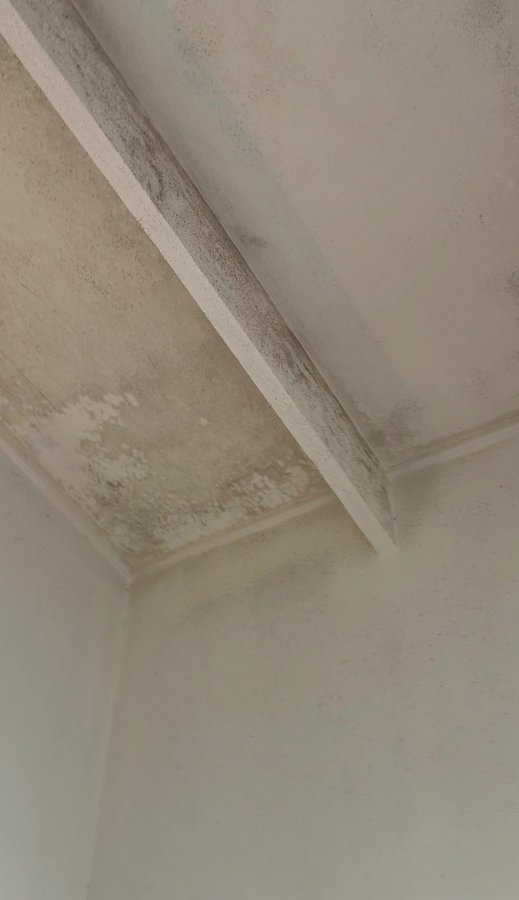
Inside the ceiling space, looking at the original raked ceiling that had been framed over in an earlier renovation.
The growth was limited to the bulkhead above the door and the top of that original raked ceiling. It sat on the back face of the sheeting, which is consistent with moisture reaching the concealed side of the lining rather than the room side. It did not extend down the plumbing stack, and none was found anywhere else. Moisture readings inside the ceiling space were elevated at the time of the works.
Where the water was coming from
There was a sump within the concealed area with what appeared to be a cracked edge, and it dripped once it was exposed.
That is consistent with the wet plasterboard and the staining recorded back in July, and it is the most likely source of the moisture. Confirming it is a job for a plumber, not for us: Mould Mates does not carry out leak detection or plumbing work. Our recommendation was to get a licensed plumber in while the cavity is open, and to hold off reinstating any lining until the source is rectified and the exposed materials are back to baseline moisture content. Close it up over an active source and the same problem comes straight back.
The part that was not mould
There was also a marking of unknown origin on the engineered timber floor around the bed that the owner was worried about.
We tape sampled it and sent it to the NATA accredited laboratory. The results came back with no elevated mould, so the marking was not attributed to mould growth and no remediation was recommended for it. Testing rules things out as often as it rules them in, and that answer saved the owner money.
Why this keeps happening around Suffolk Park and Byron Bay
Concealed ceiling mould is a pattern through this part of the Northern Rivers, and it comes down to four things stacking up.
- The climate. Suffolk Park and Byron Bay sit in a warm humid coastal zone with high ambient humidity for much of the year, so any surface that stays damp has everything it needs.
- Staged renovations. A lot of the beach stock around here has been renovated in pieces over decades. Drop ceilings get framed under raked ones, bulkheads get built, and cavities are created that nobody can see into again.
- Plumbing above wet rooms. Services run through those same ceiling spaces, and a slow drip lands on the concealed face of a lining where nothing ever shows.
- Short stay use. In a holiday letting a musty smell gets noticed, mentioned, and then normalised between guests, so years pass before anyone investigates it properly.
Mould Mates works across the Northern Rivers, from Byron Bay and Suffolk Park through Brunswick Heads, Ballina and the Tweed, as well as the Gold Coast and Brisbane. Humidity and ventilation are the background driver in most of it.
What to do if your place smells musty and you cannot find it
1 Follow the smell. Note which room it is worst in and whether it changes after rain or a shower. At this job the smell was strongest in the main space, but the source was above the en suite ceiling next to it.
2 Get the conditions measured. Humidity, dew point and moisture readings tell you whether there is a specific wet spot or the whole place is running damp.
3 Look where you cannot see. Roof spaces, subfloors, and cavities behind bulkheads and drop ceilings. Sometimes that means taking a fixture off, and sometimes it means forming an access opening under containment.
4 Fix the water before anything is closed up. Then the affected material is dealt with on its merits.
Growth on the concealed face of a porous lining cannot be treated in place. Under the IICRC S520 standard that material is removed, which is a remediation rather than a treatment.
Common questions
Do you do mould inspections in Suffolk Park and Byron Bay?
Yes. Mould Mates covers the Northern Rivers including Suffolk Park, Byron Bay, Brunswick Heads, Ballina and the Tweed, along with the Gold Coast and Brisbane. This job was inspected, sampled and remediated by us end to end.
How do you find mould inside a ceiling without wrecking the place?
You start with the conditions and the smell, then look through whatever access already exists: an exhaust fan opening, a ceiling access panel, a roof space. Only when the evidence points at a specific cavity is an opening formed, and that is done under containment.
Does a building and pest inspection pick up concealed mould?
Not usually. A building and pest inspection covers what is accessible and visible on the day. Growth on the back face of a ceiling lining inside a closed cavity is neither, which is why one was carried out at this property without anything being noted.
Is concealed mould only a problem in older buildings?
No. It follows renovations and plumbing more than age. Any building where a ceiling has been framed over, a bulkhead built, or services run above a wet room can end up with a cavity that holds moisture and never gets looked at.
If your place smells musty and you cannot find it
If you have a smell you cannot place, in Suffolk Park, Byron Bay or anywhere across the Northern Rivers, it is coming from somewhere. We inspect, measure and report on what is causing it, then quote the work that fixes it.
Request a Free Quote, or call us on 0435 219 425. Free quote within 24 hours.
Common questions
Do you do mould inspections in Suffolk Park and Byron Bay?
Yes. Mould Mates covers the Northern Rivers including Suffolk Park, Byron Bay, Brunswick Heads, Ballina and the Tweed, along with the Gold Coast and Brisbane.
How do you find mould inside a ceiling without wrecking the place?
You start with the conditions and the smell, then look through whatever access already exists: an exhaust fan opening, a ceiling access panel, a roof space. An opening is only formed once the evidence points at a specific cavity, and it is done under containment.
Does a building and pest inspection pick up concealed mould?
Not usually. A building and pest inspection covers what is accessible and visible on the day. Growth on the back face of a ceiling lining inside a closed cavity is neither.
Is concealed mould only a problem in older buildings?
No. It follows renovations and plumbing more than age. Any building where a ceiling has been framed over, a bulkhead built, or services run above a wet room can end up with a cavity that holds moisture and is never looked at.
About the author

Nicholas Smart
Nicholas Smart co-founded Mould Mates after 15 years as a qualified carpenter, and is studying a Bachelor of Construction Management. That background is the reason he tends to find the cause rather than the patch. Mould is a building problem before it is anything else, and knowing how a roof, a wall cavity or a subfloor is put together is what tells you where the water is getting in and why the same corner keeps growing the same thing. He works across the Gold Coast and Northern Rivers.
- Qualified carpenter, 15 years on the tools
- Studying a Bachelor of Construction Management
- Co-owner of an IICRC Certified Firm