Local case study 3: Arundel, mould in an enclosed under-stair cupboard
A slow leak inside a hot water tray. Nothing ever reached the floor. Months later there was heavy mould through an enclosed cupboard under the stairs that nobody had opened. Here is why the water never had to escape to cause it.
The short answer
Mould took over that space because a slow leak put water into the air of an enclosed cupboard with no ventilation, and the air had nowhere to release it. The tray caught the water, so nothing ever showed on the floor, and the cupboard stayed humid long enough for growth to establish across the timber and the wall linings.
- A contained leak still produces water vapour, and an unventilated space will hold that vapour against every surface in it.
- Enclosed under stair cupboards, meter boxes, service cupboards and linen presses are the spaces this happens in, because nobody opens them and no air moves through them.
- Growth on structural timber is treated differently to growth on lining. Timber gets HEPA vacuumed and sanded. Lining gets removed.
- Dry materials do not mean no job. It means the water has gone and the contamination has not.
Why did mould take over a cupboard nobody had opened?
A leak that never reached the floor. A hot water unit that got replaced. And then, months later, severe mould growth inside an enclosed cupboard under the stairs that nobody had looked in.
This one is worth understanding, because the water in it never went anywhere. It just evaporated.
What did we actually find?
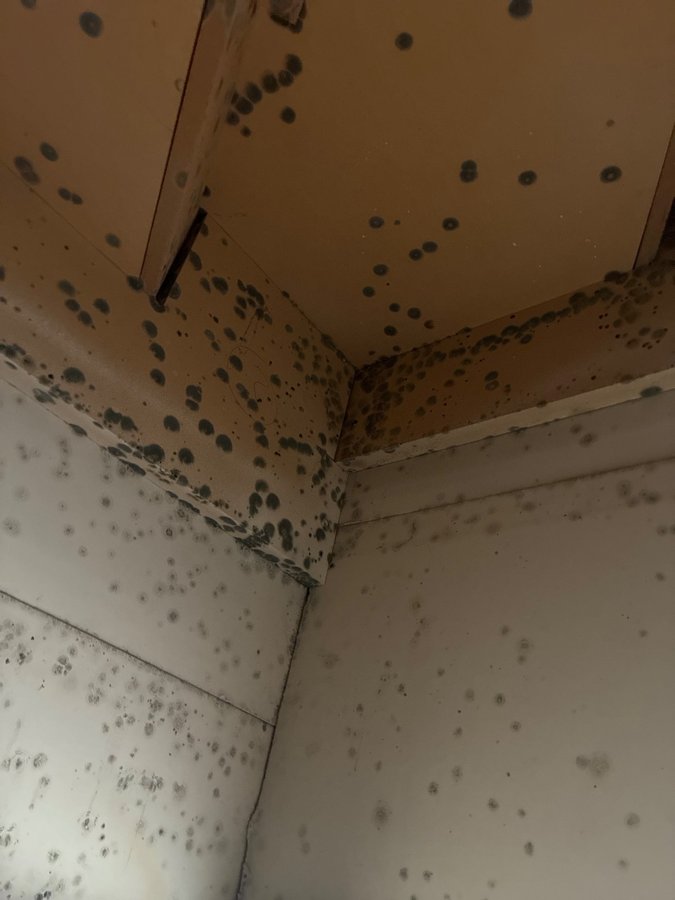
Heavy colonisation across the underside of the structural components of the staircase and the gyprock wall linings inside the cupboard, covering a large proportion of the accessible surfaces rather than sitting in isolated spots, with a strong earthy odour in the space.
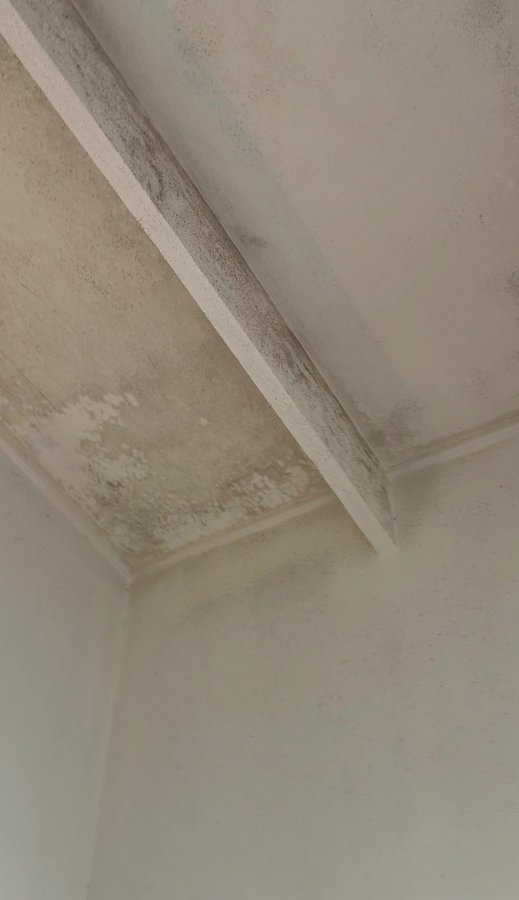
The building managers reported a slow leak inside the hot water system tray, over a period of time. The tray had done its job and contained the water, and the unit had since been replaced. Growth had also spread onto the raked section of the laundry ceiling next door, continuous with the cupboard rather than a separate outbreak.
Heavy mould colonisation on wall linings inside an enclosed under-stair cupboard at an Arundel property
Inside the under-stair cupboard at Arundel. Enclosed, unventilated and out of sight, which is how it got this far without anyone noticing.
What did the readings say?
The water closet read 22.3 degrees and 65.8 per cent relative humidity, dew point 15.6. The kitchen read 22.0 and 62.9.
No moisture readings were taken, and the report says why: no thermal anomalies were detected, and all accessible materials in the affected areas were dry to the touch. That is consistent with the reported water source having ended before we attended.
That combination is the finding. Dry materials, no thermal anomaly, and heavy established growth means you are looking at the aftermath of a condition rather than an active one, and it changes the scope. There is nothing to dry out. There is a lot to remove.

Mould growth on wall linings adjacent to a hot water system at an Arundel property
The hot water unit that sat in the tray. The leak was contained, the evaporation was not, and the cupboard had no way to remove the leak.
What was the cause?
Sustained condensation inside an enclosed, unventilated under stair space, driven by evaporation from the reported leak. Condition 3 under the S520 standard, across two rooms.
That is worth sitting with, because most people expect a leak to leave a stain, a tide mark or a soft patch. This one left none of those. It left humidity, in a space with no path for it, for long enough that every surface in the cupboard became a growth surface.
What was the scope?
Full containment with HEPA filtered negative air before anything was touched, because disturbing growth at that level without controls spreads it through the rest of the building.
The affected gyprock comes out, cut back at least 600 mm beyond the last visible growth, along with the raked laundry ceiling lining. The staircase timber is structural, so it is not removed: it gets HEPA vacuumed and sanded, with no antimicrobial applied to the timber. If the timber turns out to be degraded, works stop and a builder or structural engineer is engaged before anything continues.
That last condition matters. A remediation scope has to be able to stop when it finds something outside its own competence.
What to check at your place
- Open the cupboards nobody opens. Under stairs, service cupboards, the linen press against an external wall, the cupboard the hot water unit sits in.
- A tray is not a fix. It contains water, and contained water still evaporates. If something has been leaking into a tray, the space around it is the thing to look at.
- Trust the smell. A strong earthy odour in an enclosed space is worth opening up before there is anything to see.
- Dry does not mean finished. Growth on dry material is still growth, and the material condition decides whether it is treated or removed.
Common Questions
Can mould grow without a visible leak?
Yes. A contained leak, a slow evaporation source or simply high humidity in an unventilated space will support growth without any water ever reaching a floor or leaving a stain. That is why enclosed cupboards and service spaces turn up in inspections so often.
Does mould on structural timber mean the timber has to be replaced?
Not usually. Sound structural timber is HEPA vacuumed and sanded rather than removed, and no antimicrobial goes onto it. Where the timber is degraded, that is a builder or structural engineer question and the remediation stops until it is answered.
Why remove the plasterboard if everything is dry now?
Because the growth is in the material rather than on it. Plasterboard is porous, and once mould has established in a sheet at that level of colonisation no surface product reaches it. Drying out afterwards does not undo that.
Why does the removal go 600 mm past the visible growth?
Because the edge of what you can see is not the edge of the growth. Cutting back a minimum of 600 mm beyond the last visible growth is the S520 approach to making sure the removal actually captures the affected area.
Get it looked at properly
If something has been leaking into a tray, a cavity or an enclosed space at your place, the useful question is what the air in that space has been doing since. We measure it, open it up where it is warranted, and put the reasoning in writing.
Nick Smart, Mould Mates
Common questions
Can mould grow without a visible leak?
Yes. A contained leak, a slow evaporation source or simply high humidity in an unventilated space will support growth without any water ever reaching a floor or leaving a stain. That is why enclosed cupboards and service spaces turn up in inspections so often.
Does mould on structural timber mean the timber has to be replaced?
Not usually. Sound structural timber is HEPA vacuumed and sanded rather than removed, and no antimicrobial goes onto it. Where the timber is degraded, that is a builder or structural engineer question and the remediation stops until it is answered.
Why remove the plasterboard if everything is dry now?
Because the growth is in the material rather than on it. Plasterboard is porous, and once mould has established in a sheet at that level of colonisation no surface product reaches it. Drying out afterwards does not undo that.
Why does the removal go 600 mm past the visible growth?
Because the edge of what you can see is not the edge of the growth. Cutting back a minimum of 600 mm beyond the last visible growth is the S520 approach to making sure the removal actually captures the affected area.
About the author

Nicholas Smart
Nicholas Smart co-founded Mould Mates after 15 years as a qualified carpenter, and is studying a Bachelor of Construction Management. That background is the reason he tends to find the cause rather than the patch. Mould is a building problem before it is anything else, and knowing how a roof, a wall cavity or a subfloor is put together is what tells you where the water is getting in and why the same corner keeps growing the same thing. He works across the Gold Coast and Northern Rivers.
- Qualified carpenter, 15 years on the tools
- Studying a Bachelor of Construction Management
- Co-owner of an IICRC Certified Firm