What is there a musty smell in my house?
If you can smell mould but cannot see it, the growth is usually concealed. Three real jobs showing where we find it and how it is tracked down.
The short answer
A musty smell is mould growing on something damp. If you can smell it but cannot see it, the growth is usually concealed: behind, above or underneath a surface in the room rather than on it. That is why cleaning does not shift it. You are treating the room, and the growth is on the other side of a surface in it. Until the concealed growth is found and removed, the smell stays.
- A musty smell is active mould growth on a damp surface. It is not dust, an old house, or how often you clean.
- If you can smell it but cannot see it, the growth is usually concealed on the hidden face of something: above a ceiling, under a floor covering, or in the subfloor.
- Cleaning, airing out and dehumidifiers do not remove the smell, because they act on the room and the growth is concealed outside it.
- Where the smell is strongest is the most useful clue you have, and it is what we work from on site.
You have cleaned. You have opened the windows. You might have run a dehumidifier. The smell is still there and you cannot find anything to point at.
That is one of the most common calls we get, and the answer is nearly always the same. Here is what the smell actually is, and where Mould Mates finds it when there is nothing to see.
Why can I smell mould but not see it?
You can smell it and not see it because the growth is usually concealed. Mould only needs one damp surface, and most surfaces in a building have a side you never look at.
A studio at Suffolk Park is the clearest example I have. The owner had just bought the place, and there was a musty smell through the whole unit that stayed put with the windows and doors open. She had it professionally cleaned twice. She had a dehumidifier and moisture absorbers running. It had been let out short stay before she bought it and the smell had been mentioned back then, so it had been there a long while.
Nothing was visible. The thermal camera found nothing either, which happens more often than people expect.
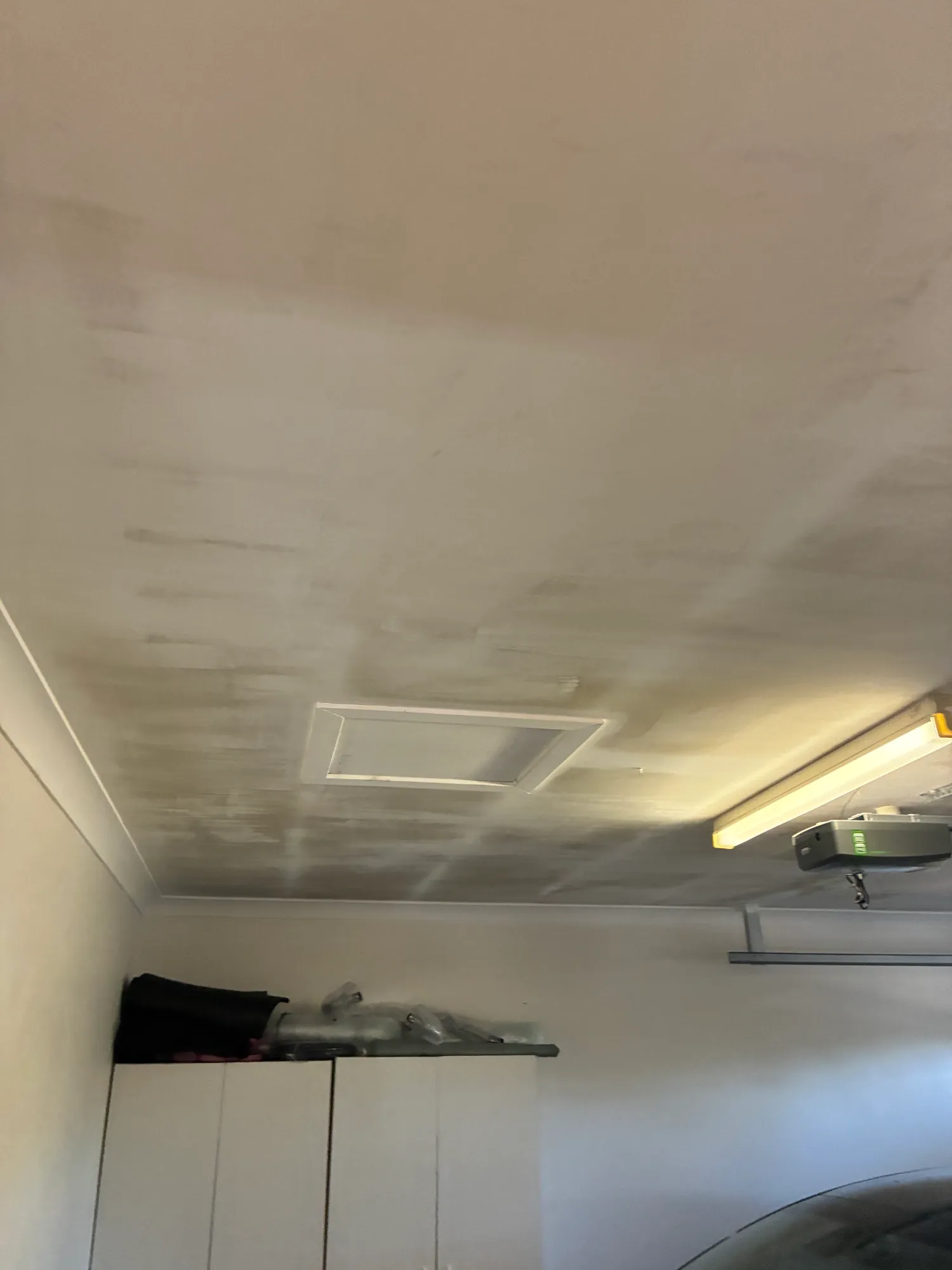
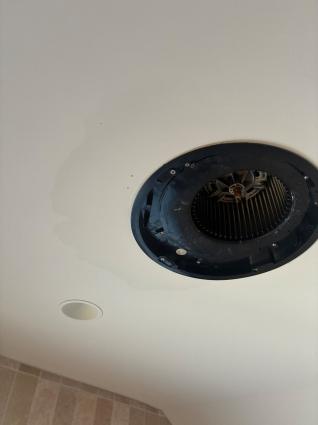
What there was, was a recent looking water stain on the en suite ceiling around the exhaust fan, and the plasterboard around it read wet. So I took the fan out and photographed the cavity above it. Sitting up there was a drop ceiling from an earlier renovation, with mould growing on the original ceiling sheeting inside it.
We opened it up properly in August. The growth was on the back face of the sheeting and on top of the original raked ceiling that had been framed over during that renovation, so every bit of it faced away from the room. Above it sat a sump with a cracked edge that dripped as soon as it was exposed.
The smell had been coming through a ceiling for years, and there was never anything to see because there was never anything on the room side. That is the whole reason we investigate before we quote.
Where is the mould usually concealed?
Concealed growth turns up in the same few places, and none of them are places you go.
- Above the ceiling. The Suffolk Park cavity, and at a home in Tallebudgera Valley the ceiling cavity had growth across the top side of the lining, roughly two square metres of it, with no insulation anywhere above.
- Under the floor covering. Carpet holds moisture against the floor beneath it, and neither side dries.
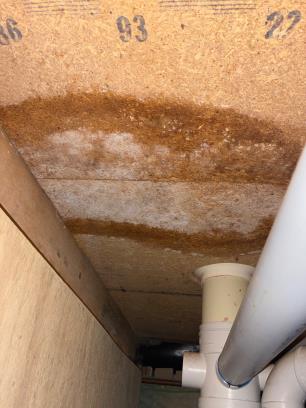
- Under the house. The subfloor at that same Tallebudgera home had a strong earthy odour right through it, with growth on the underside of the flooring and on the framing.
In that home the wet room fans discharged into the roof cavity instead of outside, and washing was being dried indoors with the laundry door shut. Moisture was being made inside and then delivered into the two spaces nobody ever looks at. Ventilation and humidity are where that starts.
The subfloor is the one that catches people out. You are standing on it, and the smell comes up through the flooring and around the edges of it, so it reaches every room without anything appearing in any of them.
The underside of the flooring at Tallebudgera Valley, photographed from the subfloor. That is the other side of the floor being walked on inside the house.
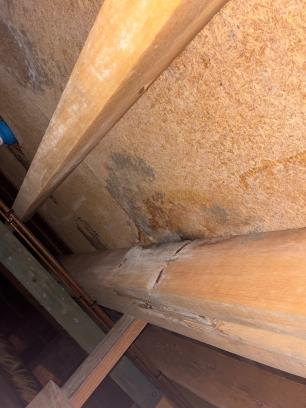
Growth spreading across the floor joists in the same subfloor. Nothing about this is visible from inside the house.
Why is the smell stronger in one room?
The smell is stronger in one room because you are standing closer to it. Smell gives you a direction, and it is worth trusting.
At a house in Pottsville the owner told me it had smelled mouldy for a while, that it was worst in the kids' bedrooms where she could not see anything, and that it seemed stronger down near the carpet. She asked me to check underneath it.
She was right. Lifting the edge of the carpet in a bedroom wardrobe, there was mould on the underside of the carpet and on the flooring beneath it. That floor read elevated against the baseline and there was water staining, so something had been wet there at some point.
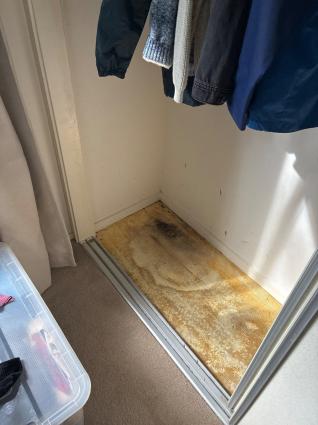
The wardrobe in the bedroom, carpet lifted out. Clothes hanging above it, growth and staining on the floor underneath.
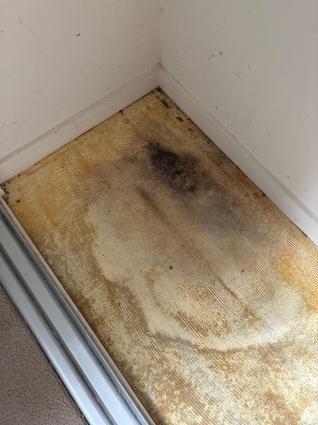
The same floor closer in. This is the face nobody sees, and it is where the smell was coming from.
She had worked out roughly where it was before I arrived, using nothing but her nose. Most people do.
Why does the smell come back after cleaning or a dehumidifier?
The smell comes back because cleaning and dehumidifiers work on the room, and the growth is not in the room.
A dehumidifier pulls moisture out of the air, which is worth doing where humidity is the driver. It does not reach the top side of a ceiling sheet or the underside of a carpet. Neither does cleaning, and neither does airing the house out.
That Suffolk Park studio had been cleaned twice by professionals with a dehumidifier going, and the smell never moved. That is not a failure of the cleaning. It is a sign you are looking at the wrong surface.
Does a musty smell always mean mould?
No, and we would rather tell you that than sell you work you do not need.
At the same Suffolk Park job there was marking on the engineered timber floor around the bed that the owner was worried about. It looked like it could have been growth. We tape sampled it and sent it to the NATA accredited laboratory, and the results came back with no elevated mould. The marking was not attributed to mould and nothing was recommended for it.
Testing rules things out as often as it rules them in. Both answers are worth having.
How do you find mould you cannot see?
We find it by measuring the conditions first, then getting into the spaces the smell points at.
That means humidity, temperature and dew point readings room by room, moisture metering on any lining that looks suspect, and thermal imaging, which shows temperature differences rather than mould and does not always show anything at all. Then the physical part: into the roof space and the subfloor, lifting an edge of carpet, or taking a fixture apart the way we did with that exhaust fan. Where there is genuinely nothing to look at, air or surface samples go to the NATA accredited lab.
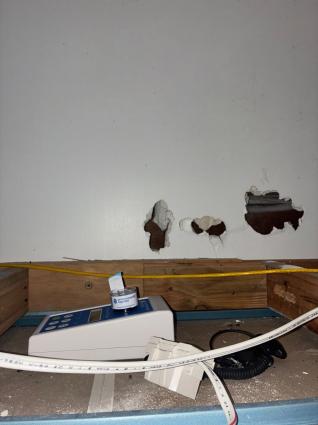
Air sampling running inside the roof cavity space at the Suffolk Park studio. The dark marks on the sheeting behind the pump are the concealed growth.
No single one of those finds it on its own. The smell tells you roughly where, the readings tell you whether there is moisture there, and then somebody has to physically get eyes on it.
What to do about a musty smell
Do not mask it. Find where it is coming from, fix the water, then deal with the material. In that order.
1 Follow the smell. Note which room it is worst in, whether it is stronger low or high, and whether it changes after rain or a shower. That is real information and it saves time on site.
2 Get the conditions measured. Humidity, dew point and moisture readings tell you whether there is a specific source or the whole house is simply running damp.
3 Fix the water first. At Suffolk Park that means a licensed plumber confirming and repairing the sump. Closing a cavity back up over an active source puts you straight back where you started.
4 Let the material decide. Surface growth on sound, dry material is treated. Growth on the concealed face of a porous lining, or under a carpet that has been wet, cannot be treated in place. Under the IICRC S520 standard that material comes out.
That is the difference between a treatment and a remediation, and it is decided by the material, not by how bad the smell is.
Common questions
Does a musty smell mean there is mould in the walls?
Not usually walls. Most of the hidden growth we find is above a ceiling, under a floor covering or in the subfloor, because that is where moisture collects and sits. Walls do happen, generally where water has run down inside one from above.
Will a dehumidifier get rid of a musty smell?
It will lower the humidity in the room, which is worth doing, but it will not remove growth on the hidden face of a ceiling or under a carpet. If the smell survives a dehumidifier, that is a sign the source is a surface you cannot see.
Why does the smell come back after I air the house out?
Airing out moves the air, it does not remove what is producing the smell. The source is untouched, so within a few hours of closing the house up the smell is back.
Can you find hidden mould without cutting holes in my walls?
Usually. Most of what we find is reached through a roof space, a subfloor, a ceiling access panel, or by taking a fixture off. Where access does have to be formed, we tell you before anything is opened and the work is done under containment.
Get it looked at properly
If you have a musty smell you cannot find, it is coming from somewhere, and the useful thing is knowing where. We inspect, measure and report on what is causing it, then quote the work that fixes it.
Request a Free Quote, or call us on 0435 219 425. Free quote within 24 hours, across Brisbane, the Gold Coast and the Northern Rivers.
Common questions
Does a musty smell mean there is mould in the walls?
Not usually walls. Most hidden growth is found above a ceiling, under a floor covering or in the subfloor, because that is where moisture collects and sits. Walls do happen, generally where water has run down inside one from above.
Will a dehumidifier get rid of a musty smell?
It will lower the humidity in the room, but it will not remove growth on the hidden face of a ceiling or under a carpet. If the smell survives a dehumidifier, the source is a surface you cannot see.
Why does the smell come back after I air the house out?
Airing out moves the air, it does not remove what is producing the smell. The source is untouched, so the smell returns within hours of closing the house up.
Can you find hidden mould without cutting holes in my walls?
Usually. Most hidden mould is reached through a roof space, a subfloor, a ceiling access panel, or by removing a fixture. Where access has to be formed, the owner is told before anything is opened and the work is done under containment.
About the author

Nicholas Smart
Nicholas Smart co-founded Mould Mates after 15 years as a qualified carpenter, and is studying a Bachelor of Construction Management. That background is the reason he tends to find the cause rather than the patch. Mould is a building problem before it is anything else, and knowing how a roof, a wall cavity or a subfloor is put together is what tells you where the water is getting in and why the same corner keeps growing the same thing. He works across the Gold Coast and Northern Rivers.
- Qualified carpenter, 15 years on the tools
- Studying a Bachelor of Construction Management
- Co-owner of an IICRC Certified Firm