Mould in the Northern Rivers: What we find in Byron Bay, Tweed Heads and Murwillumbah homes
Byron Bay morning humidity barely drops below 70 per cent. Why Northern Rivers homes get mould, what we find in Byron Bay, Tweed Heads and Murwillumbah, and what works.
- Average 9am relative humidity at Byron Bay does not drop below 70 per cent in any month of the year, from 70 per cent in August to 82 per cent in February (Bureau of Meteorology, Cape Byron Lighthouse.
- Byron Bay averages 1,735.7 mm of rain a year. Brisbane, ninety minutes north, averages about 1,048 mm.
- Mould Mates reports treat indoor relative humidity under 55 per cent as normal, 56 to 70 per cent as elevated and over 70 per cent as high. Outdoor morning air in the Northern Rivers sits in the elevated band or above every month of the year.
- Of the 84 inspections Mould Mates carried out between 7 July and 17 September 2026, 16 were in the Northern Rivers, including Byron Bay, Murwillumbah and Tweed Heads. In those reports the cause was more often ventilation or insulation than a leak.
- Ventilate a Northern Rivers house every day, because airflow dries surfaces off. Do not expect it to lower your humidity. Opening windows on a humid morning moves air without removing moisture, so a dehumidifier or air conditioning on dry is what brings the reading down.
Mould in the Northern Rivers: what we find in Byron Bay, Tweed Heads and Murwillumbah homes
Between 7 July and 17 September 2026 we wrote 84 inspection reports. Sixteen were in the Northern Rivers: Byron Bay, Mullumbimby, Murwillumbah, Tweed Heads, Banora Point, Bilambil Heights, Kingscliff, Pottsville and Lennox Head. Roughly one in five, from a business based over the border.
That is the climate here. It does a specific thing to buildings, and once you know what it is, most of these jobs stop being a mystery.
Why is mould so bad in the Northern Rivers?
The air is wetter here than almost anywhere else on the east coast, and it stays wet.
The Bureau of Meteorology station at Cape Byron Lighthouse, records average annual rainfall of 1,735.7 mm. March is the wettest month at 202.9 mm, February behind it at 189.4 mm. Brisbane, ninety minutes up the motorway, sits at about 1,048 mm.
Rainfall is the number people quote. Humidity is the one that explains the mould. Average 9am relative humidity at that station runs 70 per cent in August, the driest month, and 82 per cent in February. It does not drop below 70 in any month.
Put that against the bands on our own reports. Under 55 per cent is normal, 56 to 70 is elevated, over 70 is high. The air outside your house in the morning is in the elevated band at best, and in the high band for a good part of the year.
Does opening the windows help in Byron Bay?
Yes!
Ventilation does two things. It swaps inside air for outside air, which only lowers your humidity if the outside air is drier. It also moves air across surfaces, which dries off what condensed overnight and keeps the still corners from sitting damp. The second one works whatever the outdoor reading says. The first one, here, usually does not.
On a job at Pottsville every room read between 74.3 and 78 per cent relative humidity. The outdoor control, which we take on every investigation, came back at 76.9. Open that house up and the humidity does not move, because the air outside is carrying the same moisture as the air inside.
So open up every day for the air movement, and do it in a clear afternoon rather than first thing. When the outside air stays wet for days, which it does here every summer, a dehumidifier or the air conditioner on dry is the only thing that will bring the humidity down.
What do we actually find in Northern Rivers homes?
Across those sixteen reports it is the same four things. The cause is the building, not the weather on its own and not how the place is being lived in.
- No extraction, or extraction that goes nowhere. Bathrooms and laundries with no fan, or a fan discharging into the roof cavity instead of outside. In this climate a wet room with no working extraction will grow mould. It is only a question of when.
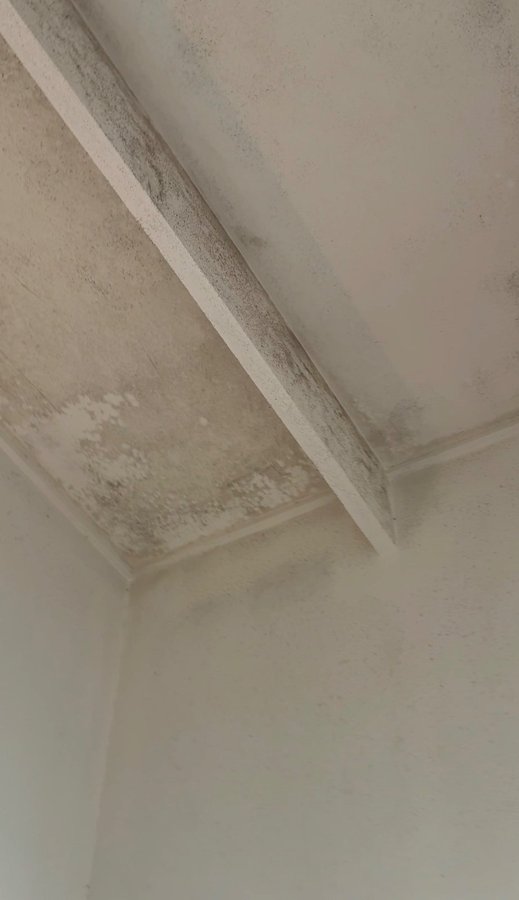
- Insulation missing or displaced. Where a section of ceiling has nothing above it, that section drops colder overnight than the ceiling around it and moisture forms on it first. That is why the growth comes up as a square or a strip instead of spreading evenly.
- Concealed growth after renovations. Ceilings framed over, bulkheads built, services run above wet rooms. Each creates a cavity that holds moisture and never gets looked at.
- Subfloors with no cross ventilation. Vents blocked by garden beds, mulch, paving and stored gear. The subfloor stays damp under a house that reads perfectly dry upstairs.
We find leaks too, but they are the minority here. Most of it is buildings that cannot get rid of moisture in a climate that keeps supplying it.
Why can I smell mould but not see it?
Because it is concealed. A smell with nothing to look at is the most common way these jobs come to us.
The same Pottsville job is the clearest example we have. Seven rooms were affected. What the owner actually called about was an extremely musty smell in a child’s bedroom, with nothing to point at.
I lifted the edge of the carpet in the wardrobe. Growth on the underside of the carpet, growth on the particleboard under it, and water damage staining that said there had been a water source at some point.
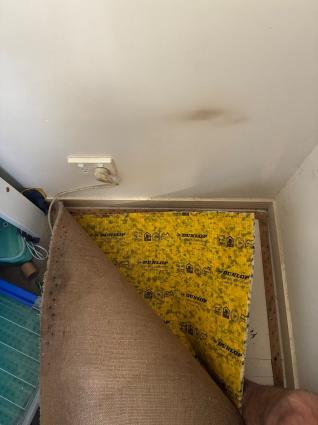
The wardrobe carpet lifted. Growth on the underside and on the particleboard below, with clothes hanging above it.
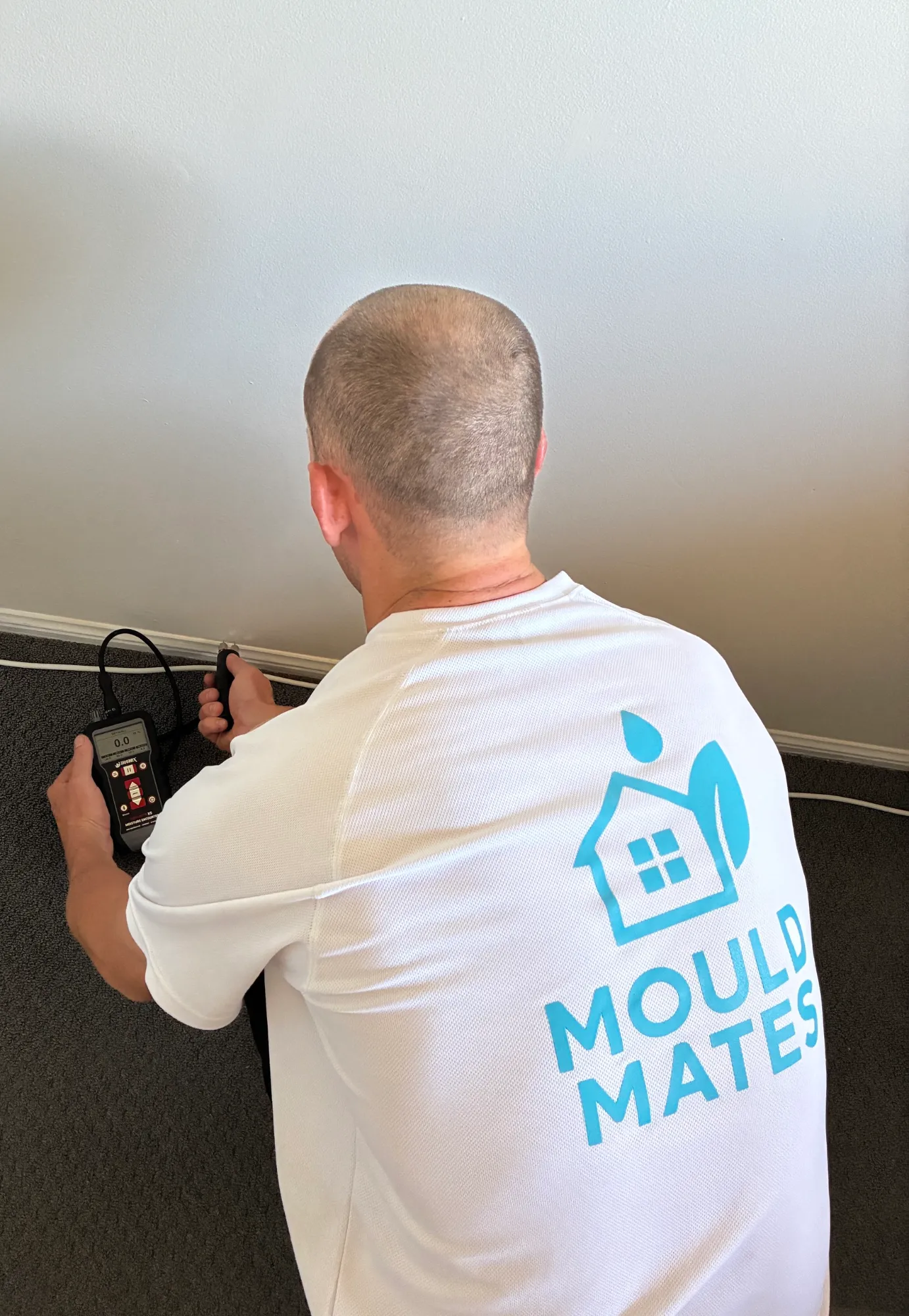
The flooring read 23.6. The dry baseline, taken on the same particleboard in a clean part of the same wardrobe, was 13.4. One reading on its own tells you nothing. The gap between the two is the evidence.
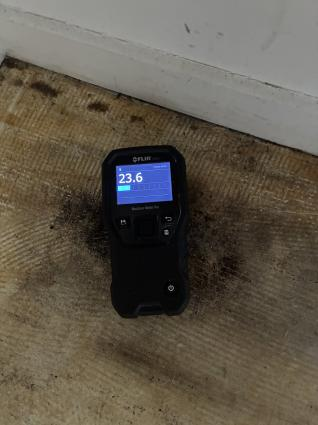
Metering the affected flooring. A reading only means something next to a baseline from the same material.
The office told us where the water was coming from. Staining across the top of the wall frame where a vent pipe passes through it. That one goes to a plumber or a builder to confirm, not to us.
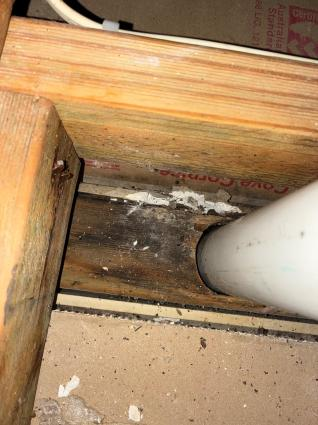
Staining to the wall frame where a vent pipe passes through. This is the sort of thing nobody sees until the lining comes off.
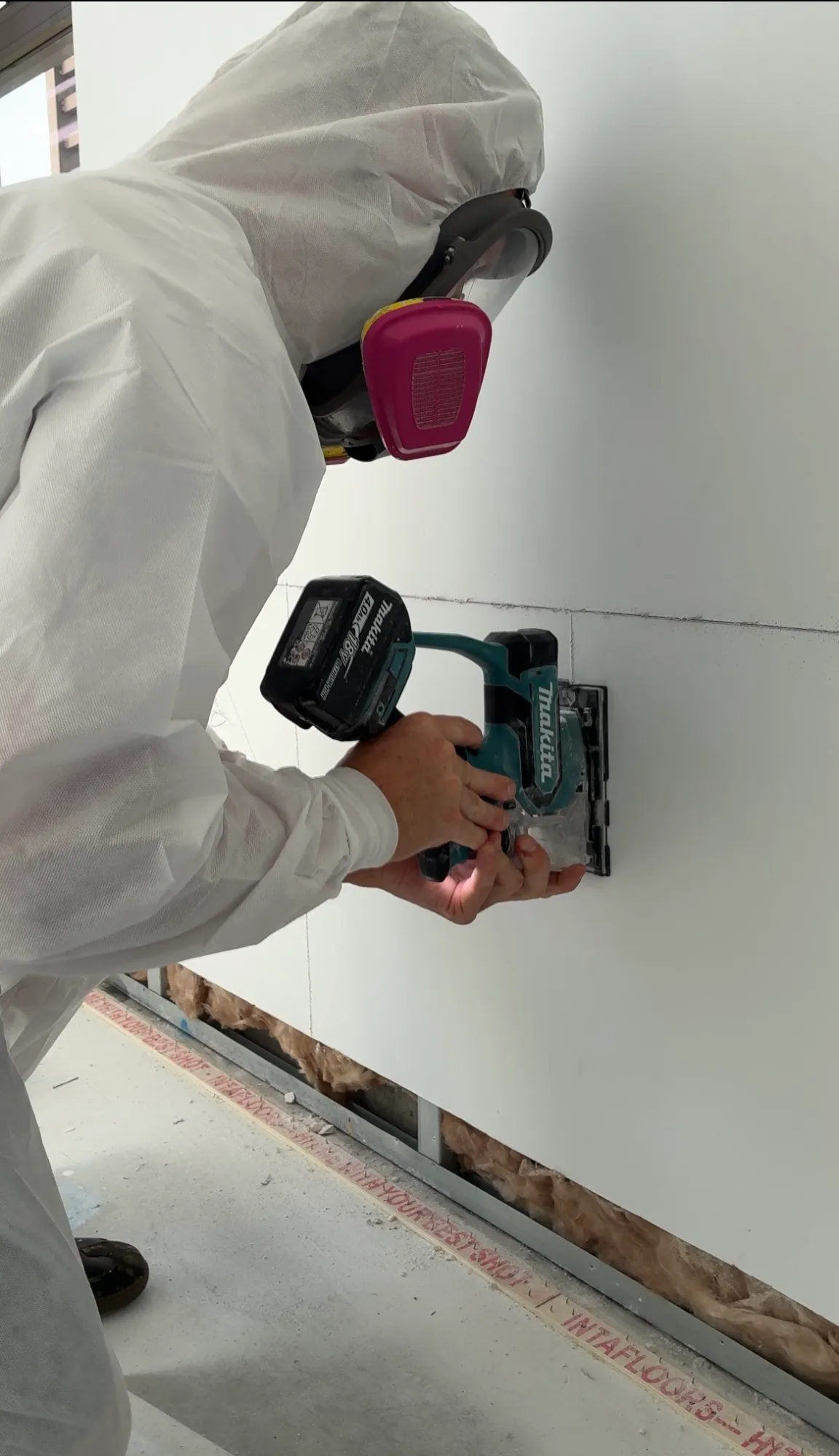
An air sample from the master bedroom went to an independent NATA accredited laboratory, and their report went into ours in full. When the growth is concealed, sampling is usually the only way to know what you are dealing with before anything gets opened up.
The bathroom had no exhaust fan. Neither did the laundry. The fan in the toilet next door discharged into the ceiling space instead of outside. Seven rooms of growth in a house with no way to get rid of the moisture it was making.
Is it different in a unit to a house?
Same mechanism, different building. The difference in a unit is that the fault is usually shared, so the fix is rarely yours alone.
We have assessed several units in the one Tweed Heads building, and that comes up regularly along the coastal strip. When three units in a block have the same problem, three households have not independently made the same mistake. It is the building: common ventilation, a shared cavity, which way the block faces, or a defect in the fabric.
That matters, because a common property defect sits with the body corporate, not the occupant. Without a written finding naming the cause, that argument goes nowhere.
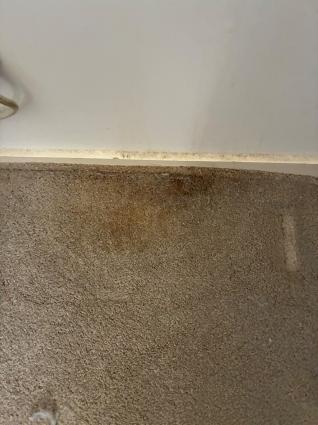
Staining and growth at a wall and floor junction on a Tweed Shire job.
What actually works in this climate

Six things, in the order they matter on this coast.
In words, in case you are on a phone:
- Keep indoor humidity under 55 per cent. Outdoor air here will not get you there on its own.
- Run a dehumidifier, or the air con on dry. The only reliable way to lower humidity when outside is wetter than inside.
- Ventilate daily, timed to the afternoon. Airflow dries surfaces whatever the outdoor reading.
- Fix wet room extraction first. The most common fault we write up in this region.
- Check insulation is flat and complete. Gaps make the cold spots where condensation lands.
- Keep subfloor vents clear. Blocked vents keep the underside damp.
Common questions
Why is mould so bad in the Northern Rivers?
Because the region combines high rainfall with humidity that never really drops. Byron Bay averages 1,735.7 mm of rain a year and its mean 9am relative humidity does not fall below 70 per cent in any month. Indoor humidity above 55 per cent is enough to support mould growth on cool surfaces, so buildings here need active moisture removal rather than relying on outdoor air.
Does opening windows help with mould in Byron Bay?
It helps with airflow, which dries surfaces off. It will not usually lower your humidity in the morning, because the air outside is carrying about as much moisture as the air inside. Ventilate every day for the movement, do it in a clear afternoon when the outside air is at its driest, and run a dehumidifier or the air conditioner on dry when the outside air stays wet.
What humidity should a Northern Rivers house sit at?
Under 55 per cent relative humidity. Between 56 and 70 is elevated. Sustained readings over 70 will put moisture on cool surfaces. Get a hygrometer, because it is the only way to know where a room actually sits.
Why can I smell mould but not see it?
Concealed growth is common here. It sits on the hidden side of a lining, in a ceiling or wall cavity, under flooring, or in the subfloor. Renovations that frame over a ceiling or build a bulkhead above a wet room leave cavities that hold moisture and never get looked at.
Who is responsible for mould in a Northern Rivers unit?
In a strata building, a defect in common property sits with the body corporate, while damage caused by an occupant sits with the occupant. The distinction turns on the cause, which is why a written investigation naming it resolves the question.
Mould investigations across the Northern Rivers
We work Byron Bay, Mullumbimby, Murwillumbah, Tweed Heads, Banora Point, Kingscliff, Pottsville, Lennox Head and the rest of the Northern Rivers, alongside the Gold Coast and Brisbane. Where there is a smell you cannot place, or growth that keeps coming back, an investigation establishes the cause and puts it in writing with the readings behind it.
Surface growth on sound, dry material is a treatment. Water that has been into the material is remediation, and remediation is done to the IICRC S520 standard. The report tells you which one you have got. Call 0435 219 425 or request a free quote.
Common questions
Why is mould so bad in the Northern Rivers?
Because the region combines high rainfall with humidity that never really drops. Byron Bay averages 1,735.7 mm of rain a year and its mean 9am relative humidity does not fall below 70 per cent in any month, measured at Bureau of Meteorology station 058009. Indoor relative humidity above 55 per cent is enough to support mould growth on cool surfaces, so buildings in this region need active moisture removal rather than relying on outdoor air.
Does opening windows help with mould in Byron Bay?
It helps with airflow, which dries surfaces, but it usually will not lower indoor humidity in the morning because the outside air is often as wet as the inside air. Ventilate daily for the air movement, time it for the middle of a clear afternoon when outdoor air is at its driest, and use a dehumidifier or an air conditioner on dry mode when the outdoor air stays wet.
What humidity should a Northern Rivers house sit at?
Below 55 per cent relative humidity. Between 56 and 70 per cent is elevated and sustained readings above 70 per cent will cause condensation on cool surfaces. A hygrometer is the only way to know where a room actually sits.
Why can I smell mould but not see it?
Because concealed growth is common in this region. It is usually on the hidden side of a lining, in a ceiling or wall cavity, under flooring or in a subfloor. Renovations that frame over an original ceiling or build a bulkhead above a wet room create cavities that hold moisture and are never inspected.
Who is responsible for mould in a Northern Rivers strata unit?
A defect in common property sits with the body corporate, while damage caused by an occupant sits with the occupant. The distinction turns on the cause, which is why a written investigation naming the cause is what resolves the question.
Which Northern Rivers areas does Mould Mates work in?
Byron Bay, Mullumbimby, Murwillumbah, Tweed Heads, Tweed Heads South, Banora Point, Bilambil Heights, Kingscliff, Pottsville and Lennox Head, alongside the Gold Coast and Brisbane.
About the author

Nicholas Smart
Nicholas Smart co-founded Mould Mates after 15 years as a qualified carpenter, and is studying a Bachelor of Construction Management. That background is the reason he tends to find the cause rather than the patch. Mould is a building problem before it is anything else, and knowing how a roof, a wall cavity or a subfloor is put together is what tells you where the water is getting in and why the same corner keeps growing the same thing. He works across the Gold Coast and Northern Rivers.
- Qualified carpenter, 15 years on the tools
- Studying a Bachelor of Construction Management
- Co-owner of an IICRC Certified Firm