Local Case Study 1: Currumbin, raked bathroom ceiling
A high raked ceiling, exposed beams, and the same growth returning to the same place. No leak, no stain, no soft patch. Here is what the readings actually showed at a Currumbin bathroom.
The short answer
The mould keeps returning at this Currumbin bathroom because the ceiling is the coldest surface in a room carrying a heavy moisture load. Every shower puts warm, wet air against a raked ceiling with no cavity above it, the beams sit at the dew point or below, and moisture condenses on them. Treatment lifts the growth off. It does not change the temperature of the beams or the moisture the room holds, which is why the pattern comes back each time the room is used.
- Condensation is a repeating problem, not a one-off event. If nothing in the room changes, the growth returns on the same surfaces.
- A raked ceiling with no cavity above it restricts air movement through the top of the room, which is where shower moisture settles.
- An exhaust fan blocked with lint and dust is not moving what it was installed to move.
- Visible growth on dry, sound materials is still Condition 3 under the S520 standard.
Why is there mould on a raked bathroom ceiling with exposed beams?
A high raked ceiling with exposed timber beams and mould spreading across it again. The owner had seen it here before, cleaned it off, and watched it return.
No leaks, no stain no soft patches. Just the same growth in the same place, on a ceiling nobody can reach without a ladder.
What did we actually find?
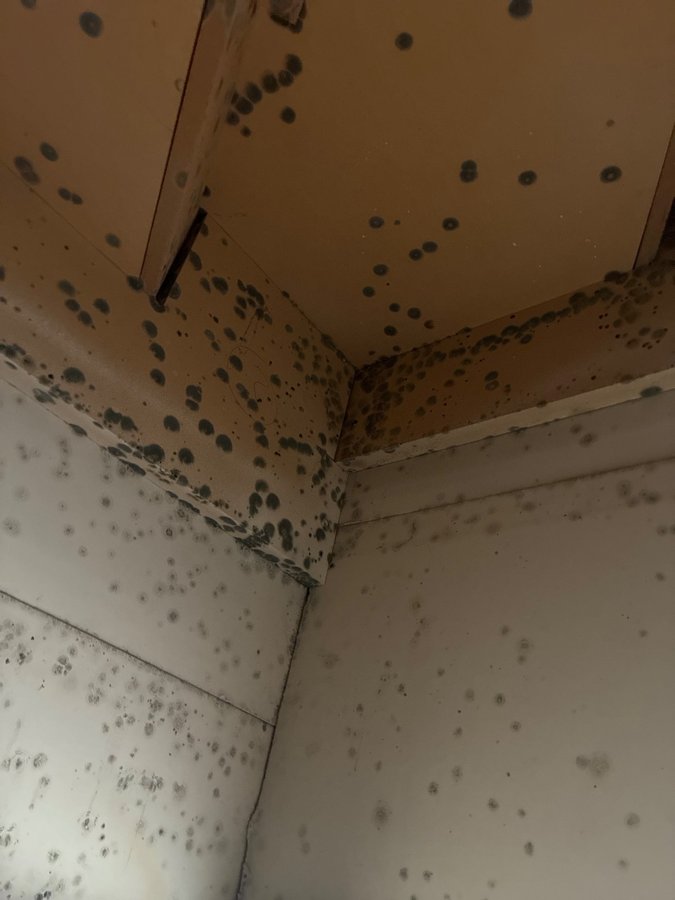
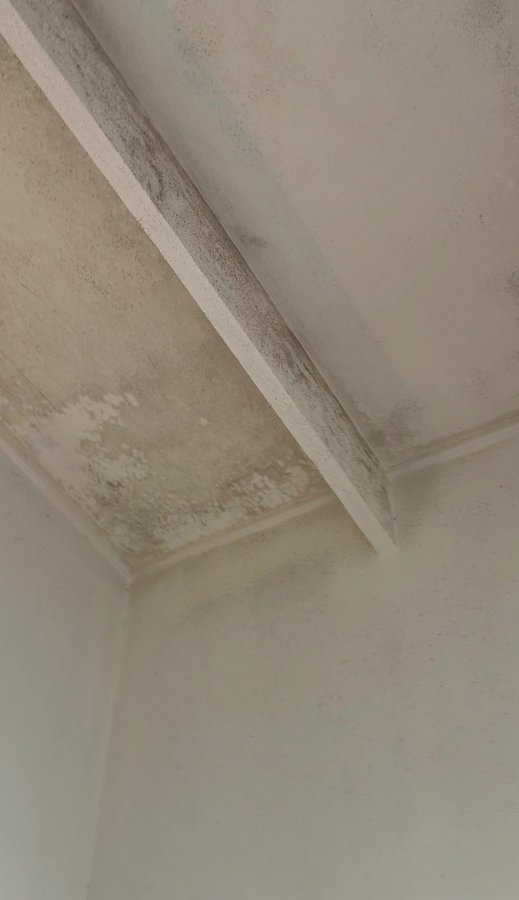
Light, surface level mould growth across the raked bathroom ceiling and its exposed timber beams, spread across the ceiling plane rather than localised to any one point.
That distribution is the tell. Growth from a direct water source concentrates around the source, and in this case it was scattered across the upper surfaces of the room. The materials were sound and dry, with no water damage or staining. The area was recorded as Condition 3 under the ANSI/IICRC S520:2024 standard, actual mould growth, across one room.
The raked ceiling and exposed beams at Currumbin. The growth sits across the whole ceiling area, which is what atmospheric condensation looks like.
What did the readings say?
The bathroom read 24.3 degrees and 62.1 per cent relative humidity, dew point 16.6. Outdoors, taken as a control, read 24.7 and 52.9, dew point 14.4.
Thermal imaging then puts a surface temperature number on the beams. Their surface temperatures were recorded at or close to that same 16.6 degrees, and when a surface sits at or below the dew point, moisture condenses onto it. The beams were already wet before anyone turned the shower on.
No moisture content readings were taken, and the report says why: the affected materials were sound and dry to the touch, with no water damage, staining or material breakdown, and no leak or flood event was reported. No thermal indications of concealed moisture in the ceiling or wall structure were found either.
What was the cause?
Condensation, driven by shower moisture collecting against a cool raked ceiling with restricted air movement.
Currumbin sits in NCC Climate Zone 2, where sustained high ambient humidity and elevated dew points across much of the year favour condensation wherever materials cool to the dew point. Add a bathroom’s moisture load to that and the p-problem increases significantly.
The raked ceiling has no roof cavity above it, so warm humid air rises, collects against the lining and the beams, and settles. Those beams are among the coolest surfaces in the room, which is where condensation forms first and dries slowest.
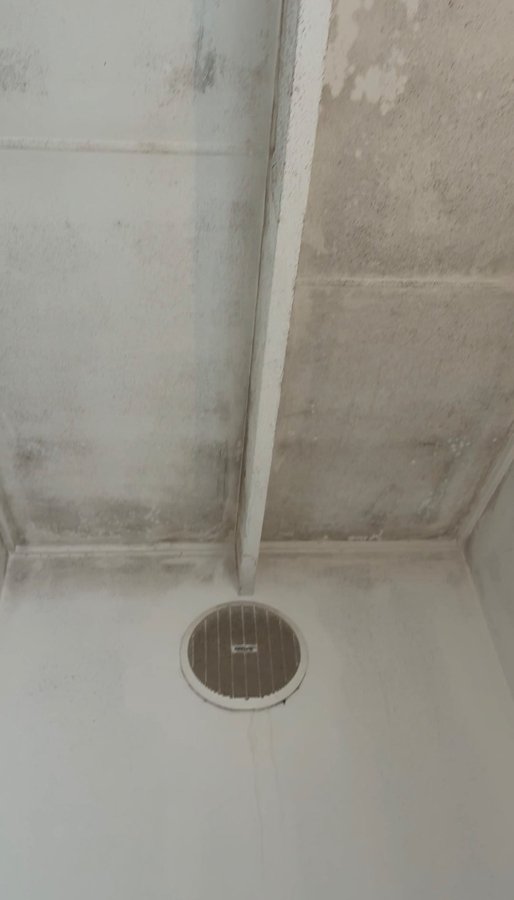
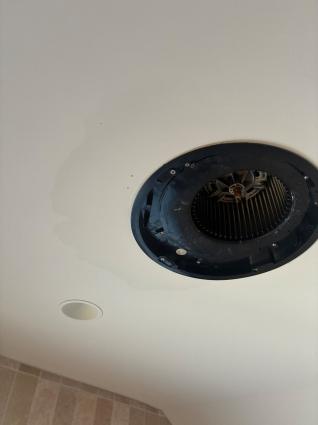
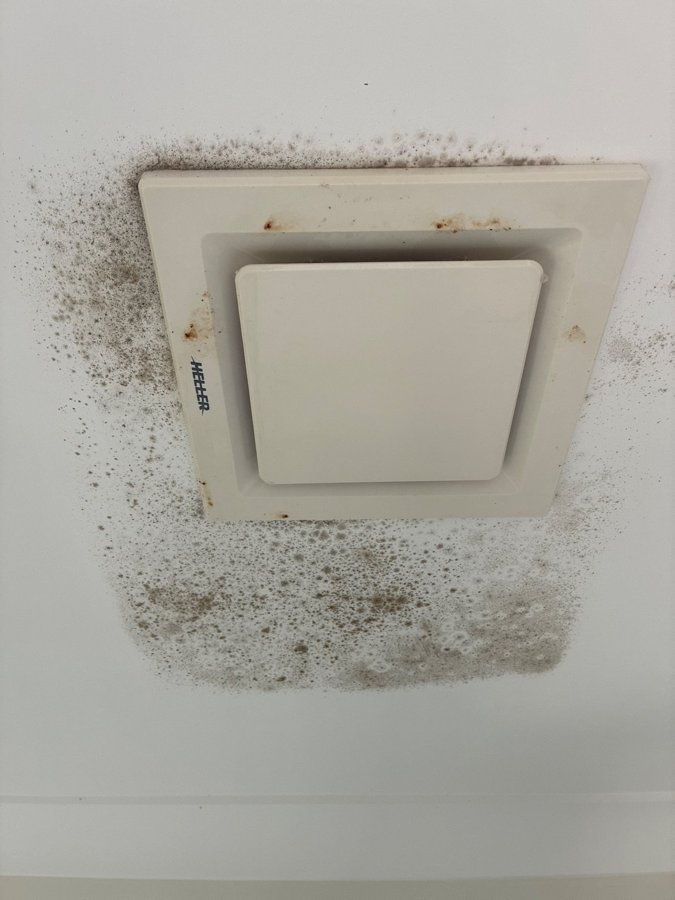
The exhaust fan above the shower, heavily blocked with lint and dust at the time of inspection.
What about the exhaust fan?
The fan grille and housing were heavily blocked, and that is an observation rather than a conclusion. Air flow was not measured and the extraction performance of the installed fan has not been assessed. We are not building certifiers, and this report does not assess the ventilation of the building against any code or standard. What we can say is that a fan choked with lint is not shifting the air it was fitted to shift, and in this bathroom, it is the main path moisture has out of the room. The NCC sets a benchmark for 25 Liters a minute removing air.
What did we recommend?
An S520 surface treatment to clear the growth, plus an ongoing mould management plan while the humidity and ventilation driver remains.
That means HEPA vacuuming of the affected surfaces, an antimicrobial clean with mechanical agitation, a bleach-based alkaline product to discourage regrowth, and whole home fogging. Grilles come off, get treated and go back on. The property is unoccupied during treatment and for two hours afterwards for dwell time.
The report is direct about the limits. Surface treatment does not rectify the moisture source, does not include containment, negative air or verification, and carries no warranty of a return to Condition 1. Where mould has penetrated the surface, it may not lift the staining. Recurrence risk here was assessed as high, because the driver is still there.
What to check at your place
- Look at your exhaust fan grille. Furred with lint and dust, it is not moving the air you think it is.
- Watch raked and cathedral ceilings. No cavity above means no passive air movement through the top of the room. And no space for insulation to protect the ceiling from cooling outdoor temperatures overnight.
- Notice where it comes back. Growth returning to the same spot tells you the moisture source was never addressed or managed sufficiently.
- Run the fan longer than the shower. The moisture stays in the room well after the water stops.
Common Questions
Why does the mould come back after I clean it?
Because treatment removes growth, not the condition that produced it. Where the driver is condensation on a cool surface, that surface goes on reaching the dew point every time the room is used.
Is mould on a dry ceiling still a problem?
Yes. Materials at this Currumbin bathroom were sound and dry, and the area was still Condition 3, actual mould growth. Dryness tells you there is no active water source, not that there is nothing to treat.
Why were no moisture readings taken?
Because nothing indicated moisture in the materials. The surfaces were sound and dry to the touch with no staining or breakdown, no leak or flood was reported, and thermal imaging found no concealed moisture. The assessment rests on the psychrometric readings, the thermal imaging and the growth pattern instead.
Would a better fan fix it?
Possibly, but we did not measure the fan and cannot say. Air flow was not tested and the extraction performance of the installed fan has not been assessed, so ventilation is a question for the appropriate trade rather than a claim we would make.
Get it looked at properly
If mould keeps returning to the same ceiling at your place, the useful question is what the surface temperature and the humidity in that room are doing. We measure both and put the reasoning in writing for you.
Common questions
Why does the mould come back after I clean it?
Because treatment removes growth, not the condition that produced it. Where the driver is condensation on a cool surface, that surface goes on reaching the dew point every time the room is used.
Is mould on a dry ceiling still a problem?
Yes. Materials at this Currumbin bathroom were sound and dry, and the area was still Condition 3, actual mould growth. Dryness tells you there is no active water source, not that there is nothing to treat.
Would a better fan fix it?
Possibly, but we did not measure the fan and cannot say. Air flow was not tested and the extraction performance of the installed fan has not been assessed, so ventilation is a question for the appropriate trade rather than a claim we would make.
About the author

Nicholas Smart
Nicholas Smart co-founded Mould Mates after 15 years as a qualified carpenter, and is studying a Bachelor of Construction Management. That background is the reason he tends to find the cause rather than the patch. Mould is a building problem before it is anything else, and knowing how a roof, a wall cavity or a subfloor is put together is what tells you where the water is getting in and why the same corner keeps growing the same thing. He works across the Gold Coast and Northern Rivers.
- Qualified carpenter, 15 years on the tools
- Studying a Bachelor of Construction Management
- Co-owner of an IICRC Certified Firm