Does bleach kill mould? What the S520 standard actually says
Bleach removes the colour from mould, not the mould. What the IICRC S520 standard says, why it comes back, and the surfaces where a bleach wipe is fine.
- Household bleach is mostly water. On porous material the water soaks in and the active chlorine stays at the surface, so the material ends up wetter than it started.
- ANSI/IICRC S520, the international standard Mould Mates works to, makes physical removal the primary means of mould remediation and states that attempts to kill or encapsulate mould are generally not adequate.
- A bleach wipe is a reasonable thing to do on tiles, grout, glass and shower screens. It is the wrong tool on plasterboard, timber, MDF, carpet and insulation.
- Queensland Health advises that bleach may not be effective at killing mould on porous surfaces, and recommends household detergents or white vinegar for general mould cleaning instead.
- Killing mould does not remove it. The standard’s reasoning is that dead mould still provokes the allergic reactions that made it worth removing, so killing it in place is not accepted as a substitute for removal.s
Does bleach kill mould? What the S520 standard actually says
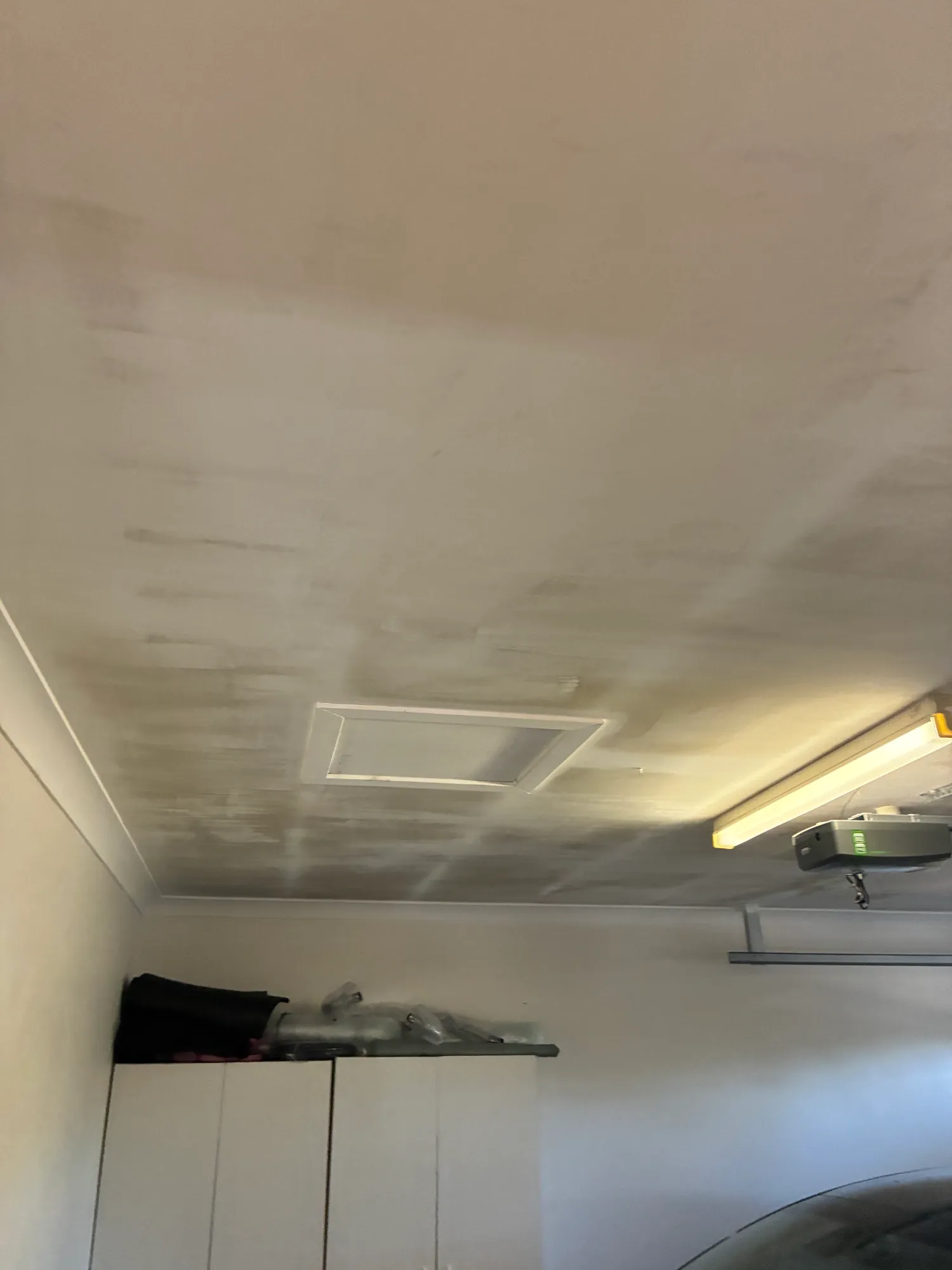
Almost everyone has been at it with a bleach spray before they call me. Bathroom ceiling, window reveal, the back of a wardrobe. They wipe it, it goes, and a few weeks later it is back in the same shape in the same spot.
Nobody has done anything wrong. Bleach on mould is the advice everybody grew up with. It is just that it does one job well and a different job badly, and the two get mixed up.
Does bleach kill mould? The short answer
Bleach removes the colour from mould growth. On a hard, non porous surface it also kills what it touches. On a porous material such as plasterboard or timber it does neither reliably, because it does not reach the growth under the surface.
- Queensland Health advises that bleach may not be effective at killing mould on porous surfaces, and recommends household detergents or white vinegar for general mould cleaning instead.
- Household bleach is mostly water. On porous material the water soaks in and the active chlorine stays at the surface, so the material ends up wetter than it started.
- ANSI/IICRC S520, the international standard Mould Mates works to, makes physical removal the primary means of mould remediation and states that attempts to kill or encapsulate mould are generally not adequate.
- Killing mould does not remove it. The standard’s reasoning is that dead mould still provokes the allergic reactions that made it worth removing, so killing it in place is not accepted as a substitute for removal.
- A bleach wipe is a reasonable thing to do on tiles, grout, glass and shower screens. It is the wrong tool on plasterboard, timber, MDF, carpet and insulation.
Why does the mould come back in the same spot?
Because what you removed was the stain, not the growth, and nothing about the room changed.
Bleach is an oxidiser. Its main effect on mould is that it strips the pigment out of it. That is why it works so fast and looks so convincing: thirty seconds and the dark patch is gone. What you have done is take the colour out, on a surface where the growth also runs below the face.
This is the part that catches people, and it is not a fair fight. The evidence disappears at the same moment the problem does not. There is no way to tell from looking at it that anything is left.
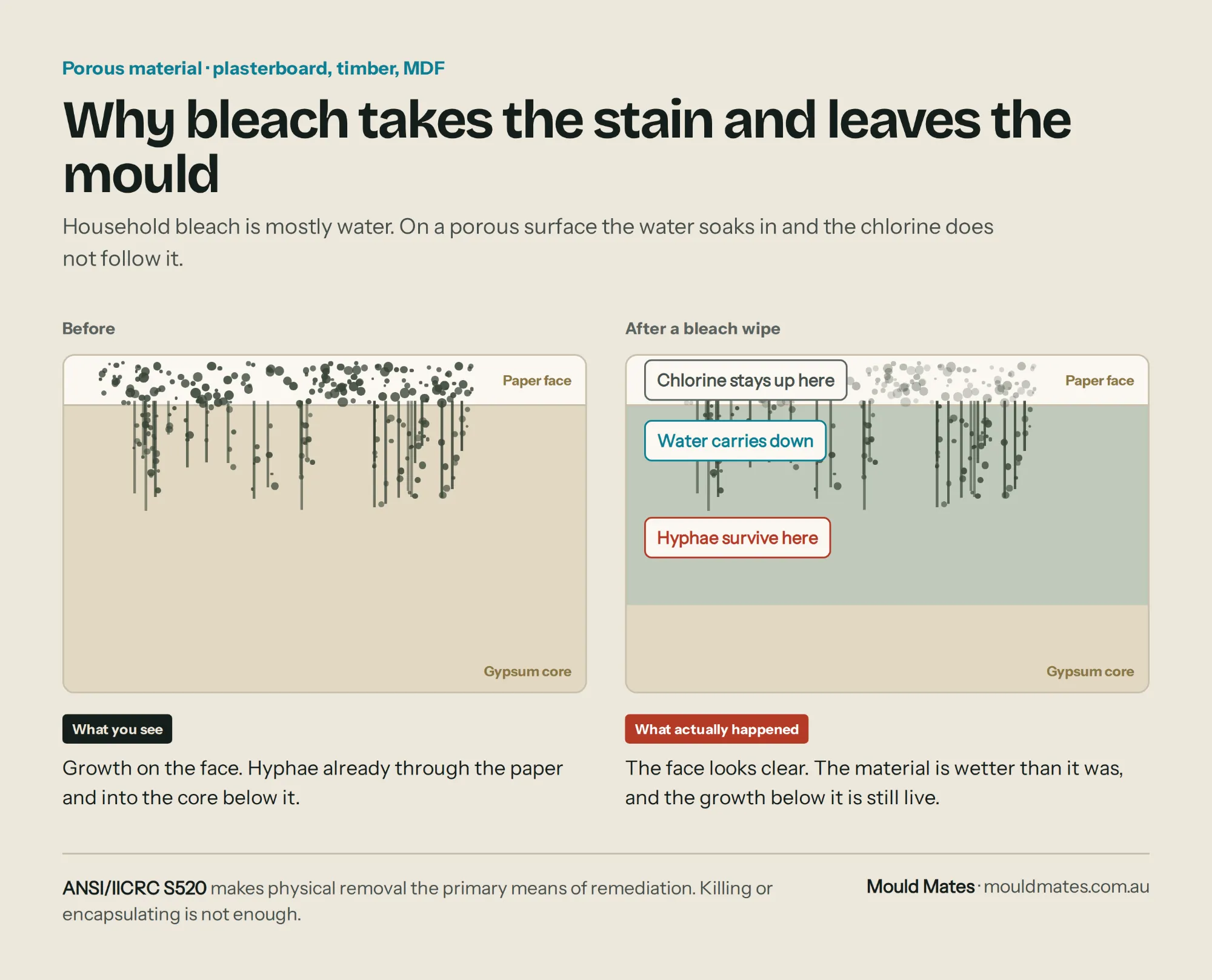
What happens when bleach meets a porous material. The face clears and the material underneath gets wetter.
And there is a second problem. Household bleach is roughly ninety five per cent water. On a material that grew mould because it was damp, you have added more water to it. I have been to plenty of ceilings that were wiped down weekly for a year, and each wipe was feeding the thing it was meant to stop.
What does the S520 standard say about bleach?
ANSI/IICRC S520 is the standard that governs professional mould remediation, now in its fourth edition, published 2024. There is an Australian version as well, AS-IICRC S520:2025.
Its position is not complicated. Physical removal of the contamination is the primary means of remediation. Attempts to kill or encapsulate mould are generally not adequate.
On biocides the standard does not ban them. It discourages them, and it allows that professional judgement might call for one in specific situations. The reasoning is worth knowing, because it is the whole argument in one line: a biocide would serve no purpose that could not be accomplished with a detergent or a cleaning agent. If you are going to physically remove the contamination anyway, the chemical is not what fixed it.
That is the gap between what people think we do and what we do. Nobody is paying us to kill mould. They are paying us to take it out of the building and find out what put it there.
If the mould is dead, is the problem fixed?
No. This is the single most useful thing to understand about mould, and it is the reason the standard is written the way it is.
Dead mould is still mould. The standard is built on the position that fragments and spores keep provoking allergic reactions whether the organism is alive or not. If the reason for taking growth off a bedroom ceiling is the people sleeping under it, killing it in place has not dealt with the reason.
The standard also points to research suggesting that treating contaminated material with a biocide can make the spores more of a problem rather than less. Either way the practical answer is the same. It has to come out of the building.
So does Mould Mates ever use bleach?
Yes, and I would rather say so than let you find out from somebody else.
We carry an oxidiser and we use it on staining, after the growth has been physically removed and the material has been assessed as sound. Water leaves a mark in timber and in paint that has nothing to do with mould and will not come out with an antimicrobial. That mark is cosmetic, and treating it is a cosmetic step at the end of a job.
What it is not is the remediation. The order matters more than the product list: antimicrobial first, physical removal of the contamination, then the stain if the client wants the mark gone. Run those in the wrong order and you have a bleached stain over live growth, which is exactly the job people call us to undo.
Where an occupant is sensitive to stronger chemicals we run a plant based antimicrobial instead. The standard does not care which bottle we pick. It cares that the contamination physically left the building.
What about vinegar instead of bleach?
Vinegar is the usual substitute and Queensland Health lists it alongside household detergents for general mould cleaning. It has the same limitation as bleach on porous material, because it is still a surface product on a problem that is not only at the surface.
It has one honest advantage. Vinegar does not bleach the pigment, so the stain does not vanish on you. If you wipe a patch with vinegar and the mark stays, that is good information to hand us: the growth is in the material, not sitting on top of it. Bleach takes that signal away.
Where a bleach wipe is actually fine
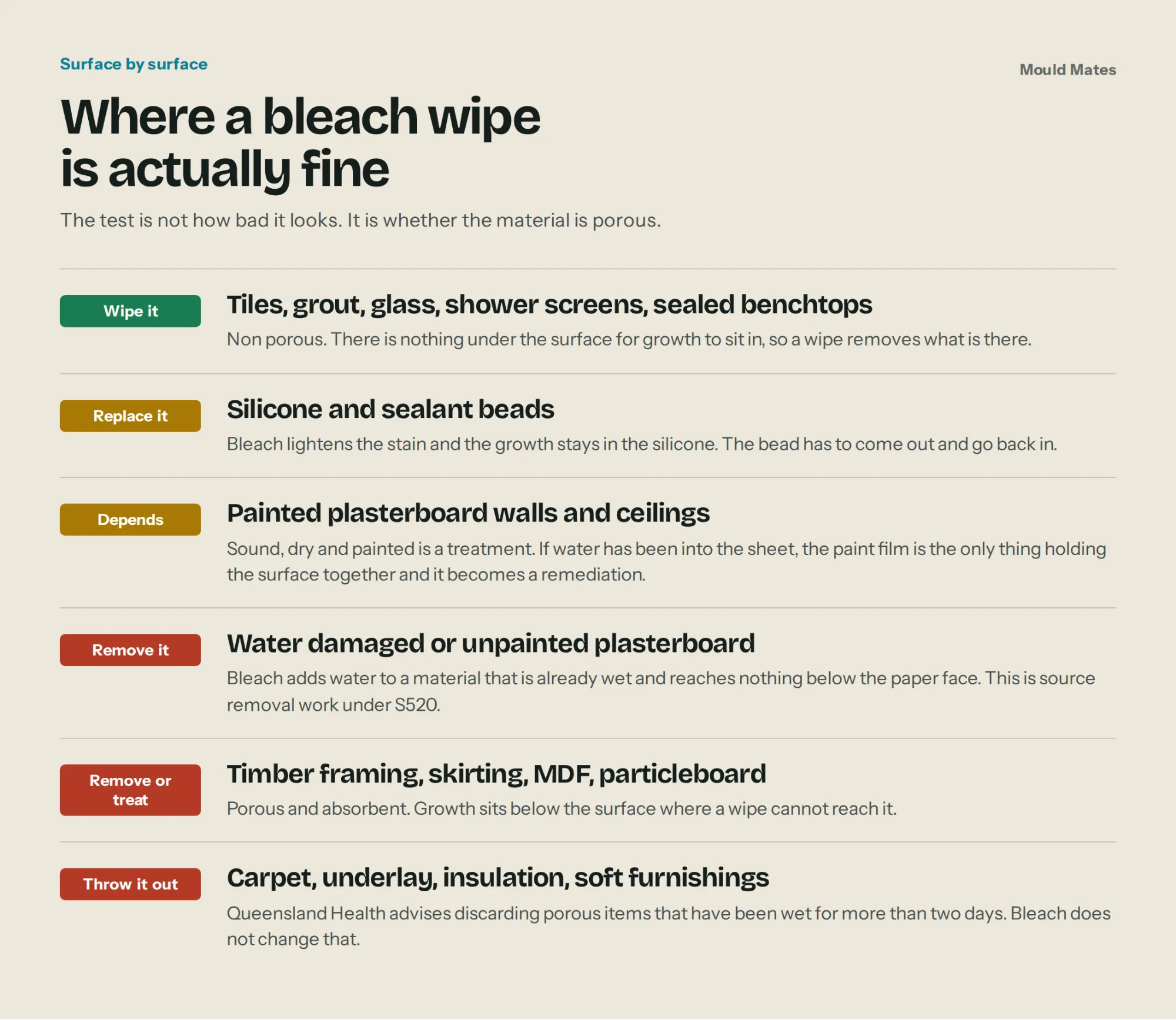
The test is not how bad it looks. It is whether the material is porous.
In words, in case you are on a phone:
- Tiles, grout, glass, shower screens. Wipe it. Nothing sits under the surface, so what you remove is what was there.
- Silicone and sealant beads. Replace it. Bleach lightens the mark and the growth stays in the silicone.
- Painted plasterboard walls and ceilings. Depends. Sound, dry and painted is a treatment. Water into the sheet makes it a remediation.
- Water damaged or unpainted plasterboard. Remove it. This is source removal work under S520.
- Timber framing, skirting, MDF, particleboard. Porous and absorbent. The growth is below where a wipe reaches.
- Carpet, underlay, insulation, soft furnishings. Queensland Health advises discarding porous items wet for more than two days.
What a surface product was never going to find
A marina office on the Gold Coast came to us as a surface complaint. Growth on the lining of a room that had been a balcony before somebody enclosed it, which is a detail that matters, because balconies are built to get wet and rooms are not.
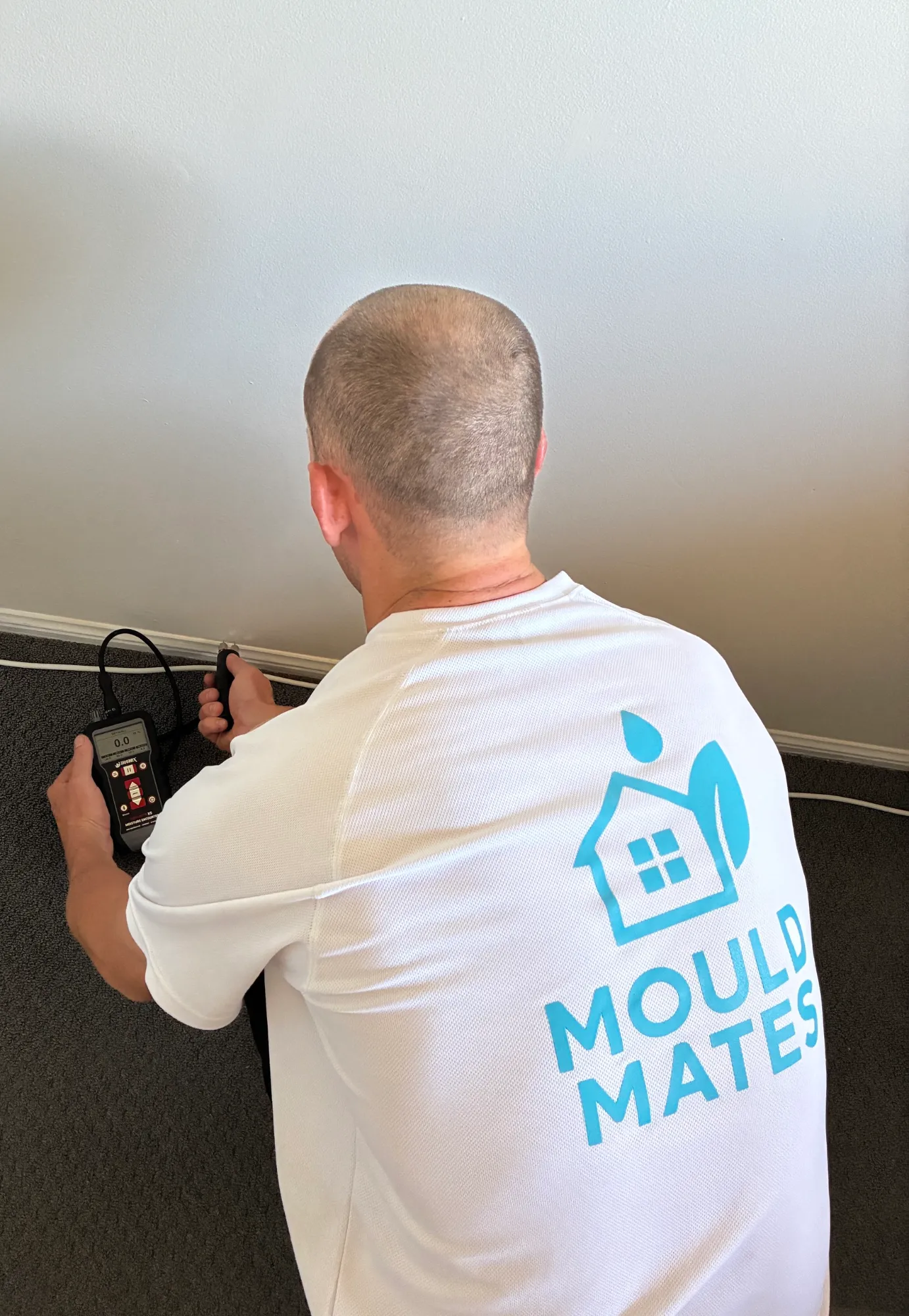
The tape lift went to a NATA accredited laboratory and came back as very high growth, with fungal hyphae well above the outdoor reference sample. That is already past anything a spray bottle addresses. When we took the sheeting off, the bottom plate under the window was rotten and reading over twenty two per cent moisture content on the meter.
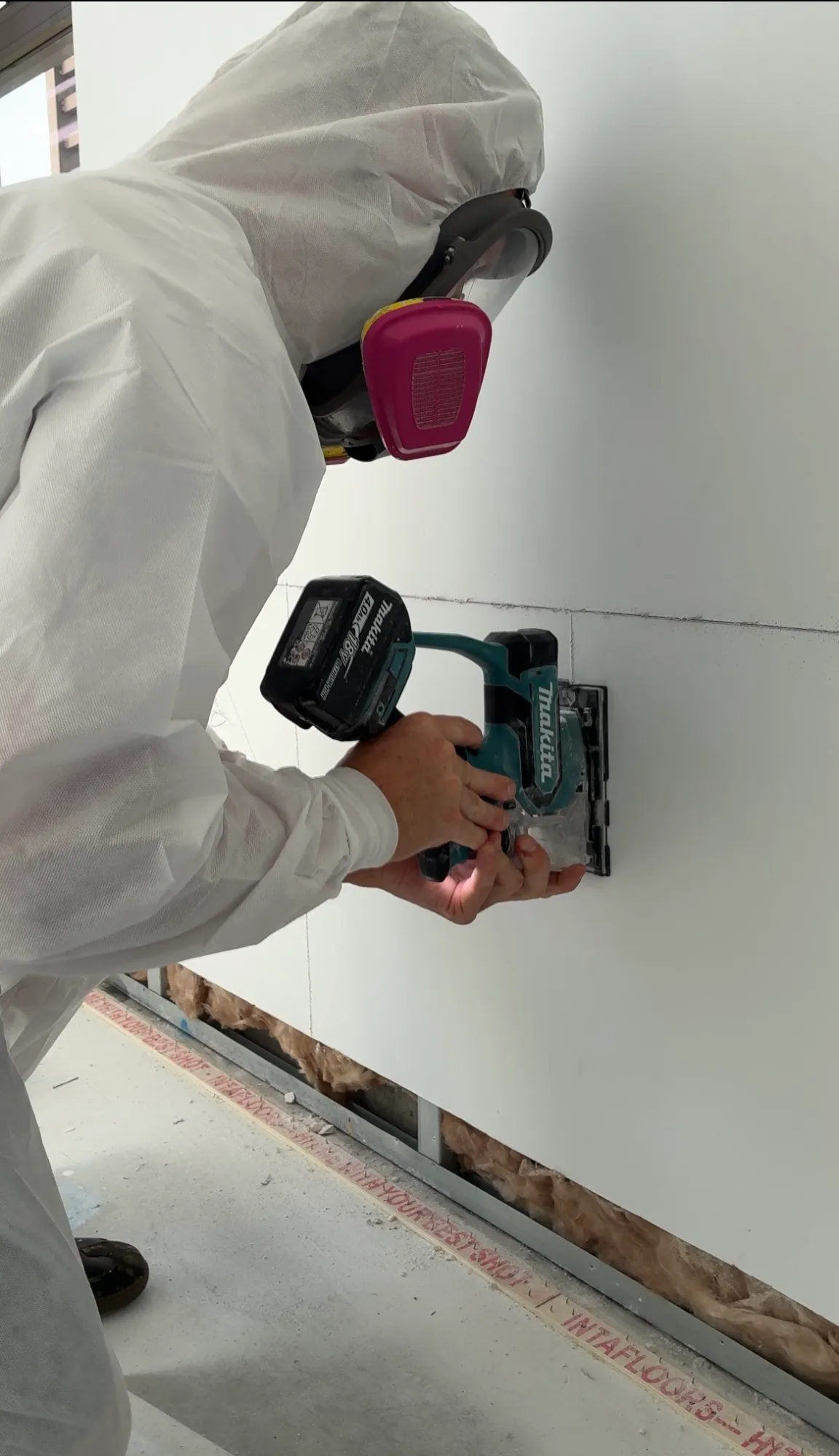
Nothing applied to the face of that wall was ever going to reach a rotten bottom plate. The wall had to come off, the framing had to be remediated, and a builder had to be involved before it went back together. Every week that it was wiped instead was a week the timber stayed wet.
Common questions
Does bleach kill mould?
On hard non porous surfaces such as tiles, grout and glass, bleach kills the growth it contacts. On porous materials such as plasterboard, timber and carpet it is unreliable, because it does not penetrate to the growth below the surface. Queensland Health advises that bleach may not be effective at killing mould on porous surfaces.
Why does mould come back after bleaching it?
Bleach removes the pigment from the growth rather than removing the growth itself, so the patch disappears while the material stays contaminated. The moisture that caused the growth is also still present, which is what allows it to return in the same place.
Does the S520 standard allow bleach?
ANSI/IICRC S520 discourages the use of biocides rather than prohibiting them, and makes physical removal of contamination the primary means of remediation. The standard notes that a biocide serves no purpose that could not be accomplished with a detergent or cleaning agent.
Is dead mould still a problem?
Under ANSI/IICRC S520, yes. The standard holds that dead mould and its fragments still provoke allergic reactions, which is why killing mould in place is not accepted as remediation. Contaminated material has to be physically removed from the building.
Is vinegar better than bleach for mould?
Queensland Health lists white vinegar and household detergents as suitable for general mould cleaning. Vinegar has the same limitation on porous material, but it does not bleach the stain, so a mark that stays after wiping tells you the growth is in the material rather than on it.
Can I bleach mould on a bathroom ceiling?
If the ceiling is painted, sound and dry, surface growth can be treated. If water has been into the plasterboard, the paint film is the only thing holding the surface together and the sheet needs assessing rather than wiping. Recurring growth on a bathroom ceiling usually points to extraction that is missing, not running, or discharging into the roof cavity.
If it keeps coming back, the bleach is not the problem
Growth that returns in the same spot is telling you about the building, not about your cleaning. A mould investigation establishes the cause and puts it in writing with the readings behind it, which is what a treatment or a remediation gets scoped from.
Surface growth on sound, dry material is a treatment. Water that has been into the material is remediation under S520. The report tells you which one you have got, and the treatment cost page shows what each one runs. Call 0435 219 425 or request a free quote.
About the author
Nicholas Smart
Nicholas Smart co-founded Mould Mates after 15 years as a qualified carpenter, and is studying a Bachelor of Construction Management. That background is the reason he tends to find the cause rather than the patch. Mould is a building problem before it is anything else, and knowing how a roof, a wall cavity or a subfloor is put together is what tells you where the water is getting in and why the same corner keeps growing the same thing. He works across the Gold Coast and Northern Rivers.
- Qualified carpenter, 15 years on the tools
- Studying a Bachelor of Construction Management
- Co-owner of an IICRC Certified Firm
This article is general information about buildings and moisture, not medical advice. If you are worried about symptoms in your home, speak to a doctor.